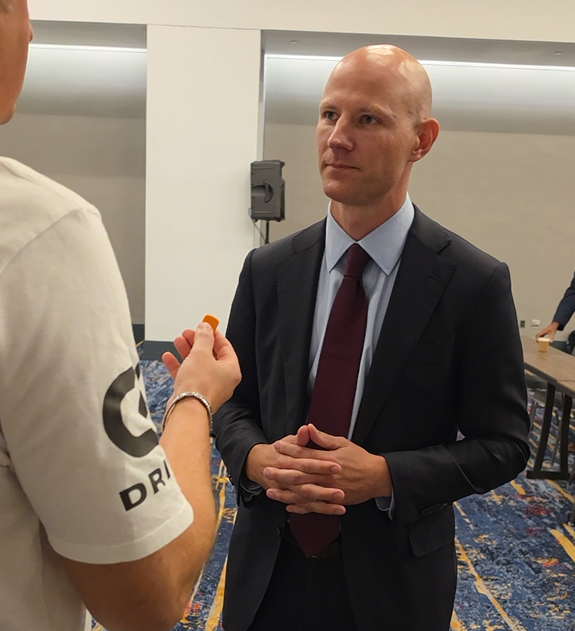
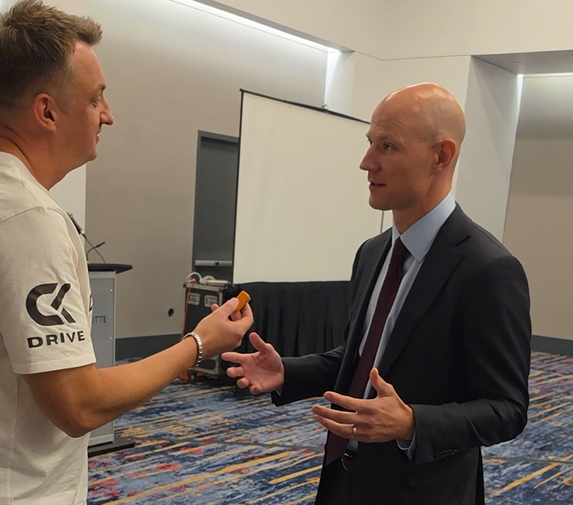
What about the hardworking men and women of America, the drivers behind the wheel doing the hard work? Does ATA represent them? Because oftentimes we hear that ATA represents the mega carriers, the big trucking companies, and the truck driver behind the wheel is often forgotten. Sure.
I mean, ATA is a membership organization, so we represent the members that are there, but the heartbeat of our industry are the professionals that make it up— drivers, technicians, fleet managers, dispatchers. Owners. I mean, even the lawyers in our industry. I mean, but everybody— companies are made up of people, and I think our policies and the language we use has to reflect that.
Sometimes it's a perception issue.
So many times, maybe, maybe it's not we're changing what we're doing, but we're changing how we talk about it.
And so, I mean, that's my— those are my values. I value people.
I know the companies that are successful in this industry value their people. That's how they keep them. They love on them. They take care of them.
Well, Mark Colson. I'm currently the president of the Alabama Trucking Association, but on December 1st, I'll become the president of the American Trucking Association. Mark, congratulations on your new role. Thank you very much.
Do you have a personal goal or priority for the year to come? What are you going to be working on? Well, I'd say my initial priority is just to listen and assess with the staff, with the membership, because I think the closer we are to our members, the more we understand their needs, their concerns, because our number one goal is to give them value. And like I just said a moment ago, to serve their interests.
So I think if I had a goal, it was to be to connect more intensely with our membership, the grassroots in the industry, listen, and then align our team, which I think— I'm not saying I think, I think we are aligned, but just more intensely aligned to serve their interests. ATRI just announced the top industry issues for 2026. There was quite a disconnect between the issues that drivers are bringing up and the carriers. Do you have an idea how to close that gap and bring the drivers and carriers together?
The transparency of that is a win in and of itself to show, hey, these are, these are the real things drivers care about. And these are the things that industry, you know, that company owners are saying they care about. And being able to challenge the industry to say, if you want to have good drivers, if you want to fulfill those drivers, you need to look at that list and assess. And that's a company— as they said, that's a company-to-company proposition.
But I do think ATA, and in this case ATRI, the simple fact of displaying that transparently is a win and is a part of that education process. And what is the one issue that ATA is bringing to Washington, D.C. on behalf of the trucking industry right now?
There's so many issues that happen at one time. You can't pinpoint one individually.
I would say one, I would mention this, the integrity of the industry, the bad actors that are in our industry, that is so important. One, because it compromises safety and it violates the trust of what our industry really represents.
And also going back to the people, the thing that it does as well is it demoralizes the hardworking men and women professionals that we were just talking about out there doing things the right way, the companies doing things the right way, and the drivers and others that are doing things the right way.
So that one kind of has a little asterisk about it, right, because it really goes towards the mischaracterization of what our industry truly stands for, because we are safety number one.
I mean, that is, that is true. You talk to any company here and they can prove that to you. And it affects everyone. Yeah, and it affects— and people want to get home.
We want everyone to get home safely.
So anybody that's going to do anything to compromise that, that's not what we're about.
So that, that one has, to me, has an asterisk by it because it's important. But there's other important issues happening at the same time.
And my last question will be about autonomous trucks. We saw Aurora and Wabi on the show floor. Is there anything HPE is doing to protect drivers' jobs in the future?
You know, not being here long, I know that technology happens, you know, whether we like it or not, but I really would like to learn more and assess that more about what ATA's position is on all those issues.
You know, technology moves fast. Do you feel it's moving a little too fast for some people in the industry? I think that's probably a perception that's out there, and so that's one of you talk about getting out there and assessing and really learning. Those are issues that probably one set that in Alabama I really haven't had to work on intensely, so that's one I know this team is working on. I look forward more to learning about where we're at and where we need to go.