

© 2026 CK Drive. All rights reserved.


Airbags Have Been Saving Lives for 50 Years. Why Are Truck Drivers Still Waiting?
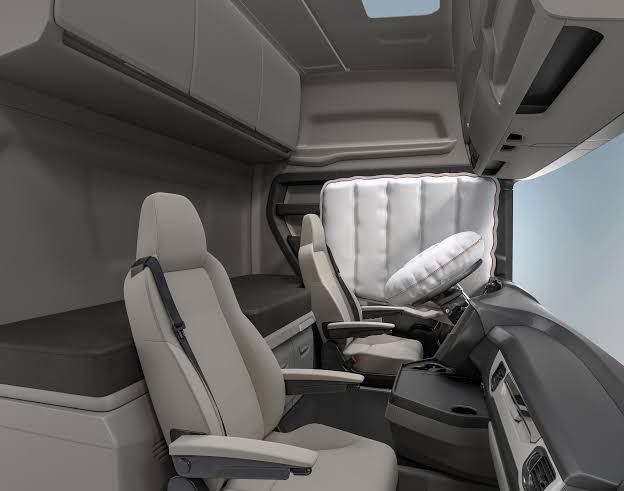
We’ve had airbags in passenger cars since the 1970s. By the 1990s, they were becoming standard equipment. Yet somehow, more than 50 years later, we're still talking about bringing some of these basic safety technologies into commercial trucks.
That was one of my biggest takeaways from my conversation with Analia Jarvis of Autoliv at the SAE International COMVEC event in Schaumburg, IL.
Autoliv is one of the world's leading automotive safety suppliers, developing airbags, seatbelts and other technologies designed to protect vehicle occupants. What surprised me was learning just how far behind commercial trucks have been when it comes to protecting the people inside the cab.
Think about it. We spend hundreds of thousands of dollars on trucks equipped with advanced engines, automated transmissions, collision avoidance systems and increasingly sophisticated technology. Yet many commercial trucks on the road still lack some of the occupant protection features we've taken for granted in passenger cars for decades.
The Technology Already Exists
The first airbags offered to American car buyers appeared in the 1974 Oldsmobile Toronado. By the early 1990s, airbags were becoming widespread, and dual front airbags became mandatory in new U.S. passenger cars for the 1998 model year.
Commercial trucking has followed a very different timeline.
Volvo introduced a driver's steering wheel airbag in its North American trucks back in 1996. More recently, Volvo became the first heavy-duty truck manufacturer in North America to make integrated side curtain airbags standard on its new VNL and VNR models.
Mack Trucks is also bringing advanced occupant protection to its new Pioneer and Anthem models, offering frontal airbags and optional side curtain airbags. Seeing Volvo and Mack invest in these systems is encouraging. My hope is that other manufacturers follow, and that more fleet buyers begin treating occupant protection as a priority rather than an optional upgrade.
These airbags are particularly important during rollovers, when a driver can suffer serious head injuries or even be ejected from the cab.
According to Volvo, rollovers account for roughly half of truck occupant fatalities. That's a staggering number, and it makes you wonder how many lives could be saved if every truck on the road offered better protection.
Analia also demonstrated newer seatbelt technology, including pretensioners that tighten belts before or during a collision and systems that adapt restraint forces to better protect different occupants.
This isn't science fiction or technology that still needs to be invented. Much of it has been used in passenger vehicles for years.
Could Safety Become a Competitive Advantage?
Here's what I'm curious about.
Fleet managers spend considerable time evaluating fuel efficiency, maintenance costs, uptime and resale value when ordering new equipment. All of those things matter.
But will driver safety become a bigger factor in purchasing decisions?
And what about the drivers themselves?
We hear constantly about driver recruitment and retention. Companies invest in newer trucks, comfortable sleepers, better seats and additional amenities to attract and keep good drivers.
Would a driver be more likely to join or stay with a company that provides a newer truck equipped with the latest safety technology?
I would think so. If I were spending weeks on the road, knowing that my employer invested in equipment designed to protect my life would certainly mean something to me.
Of course, airbags alone won't prevent every injury, and nothing replaces wearing a seatbelt. But the combination of better restraints, stronger cabs and advanced crash prevention technology could make a meaningful difference.
It's About Getting Home Safely
What I found encouraging about my conversation with Analia is that the technology is available, manufacturers are beginning to implement it, and the industry is finally having a serious conversation about occupant protection.
I hope this becomes something fleet owners actively look for when purchasing their next trucks, rather than treating it as another optional feature.
After all, trucks can be repaired or replaced. The person behind the wheel cannot.
Watch my full interview with Analia Jarvis from Autoliv to see how commercial truck airbags work, why rollover protection matters, and what the next generation of seatbelt technology could mean for professional drivers.
