From ELDs to AI: Why I Can't Imagine Running a Fleet Without Connected Technology
What started as a search for an electronic logbook nearly a decade ago has evolved into something much bigger. After years of using Samsara in my own trucking operations, I recently got a firsthand look at how artificial intelligence is taking fleet management to another level.
It All Started With the ELD Mandate
Back in 2015–2017, when I was working at Experior Transport, the trucking industry was preparing for a major change.
The federal electronic logging device (ELD) mandate was approaching, and like thousands of other trucking companies, we needed to find a provider that would help us comply with the new regulations.
At the time, most of us were simply looking for an electronic replacement for paper logbooks.
But when I discovered Samsara, something immediately caught my attention.
Here was a platform with a familiar Google Maps interface, real-time GPS tracking, an intuitive dashboard, and features that went well beyond recording drivers' hours of service.
Compared with the legacy systems I had seen, it felt like a completely different generation of technology.
For me, choosing Samsara was a no-brainer.
And it wasn't just the software that impressed me.
Whenever we contacted the Samsara team with a request to adjust something or improve a feature to better suit our operation, they were incredibly responsive.
Instead of feeling like we had to adapt our business around the limitations of the software, it felt like the software was evolving to meet our needs.
That made a lasting impression.
One Platform Instead of Ten Different Systems
Years later, when I owned and operated Kuna Cargo, I chose Samsara again.
By that point, I had come to appreciate something that sounds simple but makes an enormous difference when you're managing a fleet: having everything in one place.
GPS tracking, electronic logbooks, refrigerated trailer temperature monitoring, reefer unit sensors, IFTA mileage reporting, and other operational tools could all be accessed through the same platform.
Think about how much time fleet managers spend switching between different systems.
One application for GPS tracking. Another for electronic logs. A separate system for trailer temperatures. Another for maintenance. Yet another for fuel reporting.
Every additional platform means another login, another interface to learn, and another place to search for information.
And when you're operating a trucking company, you don't always have the luxury of time.
A customer calls asking where their load is. A driver has an issue with their hours. A refrigerated trailer needs attention. Someone in accounting needs mileage information.
You want answers immediately.
I loved how intuitive and responsive Samsara was. The information I needed was generally right there, without having to navigate through multiple disconnected systems.
Looking back, I believe the real value was never just the electronic logbook.
It was the ability to see and manage more of your operation from one place.
Nearly a Decade Later, the Technology Has Gone Much Further
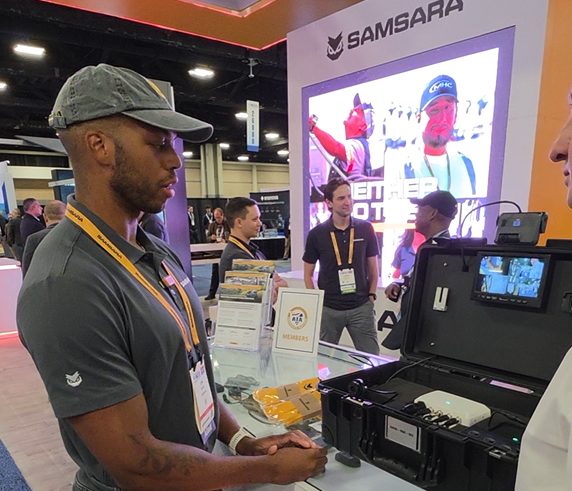
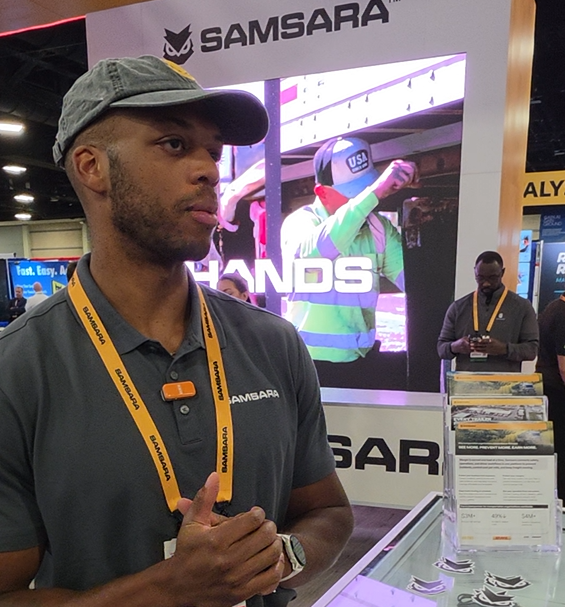
At the American Trucking Associations' 2026 Management Conference & Exhibition, I had an opportunity to reconnect with Samsara and speak with Jon Worthy, one of the company's sales engineers.
I expected to see some improvements to the platform I remembered.
What I discovered was much more interesting.
The technology has expanded into areas I could barely have imagined when we were shopping for ELDs.
AI-powered cameras, advanced fuel management, connected maintenance, intelligent asset tracking, and even AI agents capable of communicating directly with drivers.
Jon demonstrated how Samsara's Fuel Command Center can help fleets identify unnecessary idling, inefficient fueling locations, and other opportunities to reduce operating expenses.
He also showed me a multicamera system that detects pedestrians near a truck and warns the driver in real time.
But one of the most fascinating developments was agentic AI.
Jon explained that Samsara's AI agents can take on certain tasks automatically, including contacting a driver when the system detects signs of drowsiness.
Imagine it's 3 a.m. Your driver is hundreds of miles away, and you're asleep.
Instead of relying entirely on someone in your office to identify a potential problem, the technology can recognize warning signs and initiate a conversation with the driver.
That's a remarkable change from the electronic logbooks we were looking at in 2017.
And when you combine these capabilities with vehicle diagnostics and increasingly sophisticated maintenance monitoring, you begin to see how connected technology could help fleets become more proactive rather than constantly reacting to problems.
A Camera Should Be a Partner, Not Just a Supervisor
One particular part of my conversation with Jon stood out.
We were discussing AI-powered dash cameras and how they detect potentially dangerous driving behaviors.
Many professional drivers understandably have concerns about these systems.
Nobody likes the feeling of being watched constantly, especially when they're simply trying to do their job.
But Jon made an important point.
The camera shouldn't just be there to catch a driver doing something wrong. It should also be there to protect them.
If a driver becomes distracted, the system can provide an immediate warning before that mistake results in an accident.
And if another motorist causes a collision, video evidence can help establish what really happened and potentially exonerate a driver who would otherwise have difficulty defending themselves.
That second part is especially important in trucking.
A commercial truck involved in an accident can attract blame before anyone fully understands the circumstances. Having reliable video evidence can make an enormous difference.
Jon described the technology as a partner to the driver rather than simply a supervisor.
I like that philosophy.
Of course, how a trucking company uses these tools matters just as much as the technology itself.
If every alert becomes an excuse to punish a driver, the camera will inevitably feel like surveillance. But if the technology is used to improve safety, recognize good driving, and protect employees from unfair accusations, it becomes something much more valuable.
I believe that distinction is critical as AI becomes increasingly involved in transportation.
And It's Not Just About Trucking Anymore
Another thing I appreciate about Samsara is how broadly the technology can be applied.
When I first started using it, my focus was entirely on trucking.
But connected operations technology isn't limited to Class 8 highway trucks.
Delivery vehicles, construction equipment, service fleets, refrigerated trailers, and other commercial assets can all benefit from better visibility, monitoring, and operational data.
Different businesses have different needs, but many of their problems are remarkably similar.
Where is my equipment? Is it being used efficiently? Is it operating safely? Does it need maintenance? How much money am I wasting without realizing it?
Technology that helps answer those questions can be valuable whether you're operating five delivery vans or a fleet of 500 trucks.
And bringing more of that information together in one platform is a major advantage.
Technology Should Make Running a Fleet Easier, Not More Complicated
I've spent enough time in trucking to know that no software platform can solve every operational problem.
Trucks will still break down. Drivers will still make mistakes. Fuel prices will still fluctuate. And AI systems won't always get everything right.
But I also know how much time and money can be lost simply because the right information wasn't available when you needed it.
Looking back at my experience with Experior Transport and Kuna Cargo, I can't imagine wanting to run a fleet today without access to modern connected technology.
Not because every new feature is essential, or because AI will magically eliminate the challenges of trucking.
But because running a fleet is already complicated enough.
The last thing an owner, dispatcher, safety manager, or driver needs is another disconnected system creating more work.
What impressed me most during my conversation with Jon wasn't one particular camera, sensor, or AI feature.
It was seeing how much the technology has evolved from the simple ELD solution I originally needed.
We started by using technology to comply with regulations. Today, we're using it to help make better decisions, reduce costs, protect drivers, and manage entire operations.
And the next generation of AI could take that even further.
For someone who remembers the days of paper logbooks, phone calls to find out where trucks were, and constantly switching between different systems, that is a remarkable transformation.
I am genuinely curious to see where it goes next.
Watch my full conversation with Jon Worthy of Samsara on CK Drive, where we explore fuel savings, AI-powered safety cameras, intelligent tracking, connected fleet management, and how AI agents could change the way fleets operate.