.png)

© 2026 CK Drive. All rights reserved.
.png)

The AI Scanner That Can Find What You Missed on Your Car
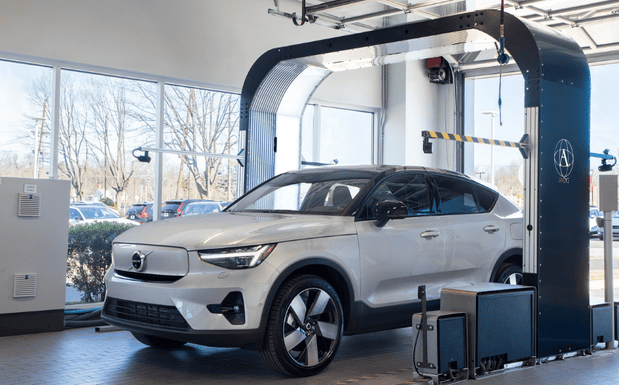
What if every time your car entered a dealership, rental facility or parking lot, a machine could inspect it in seconds and remember exactly what it looked like the last time it saw it?
It could notice that your tire tread changed, find a new scratch on the bumper, photograph something leaking underneath the vehicle and potentially identify damage that you didn't even know was there.
That technology already exists, and the story of how it got into automotive dealerships is probably not what you would expect.
The system wasn't originally created to sell you tires or find scratches on rental cars. Its roots are in security, where the problem was much more serious: how do you quickly inspect the underside of a vehicle for something that shouldn't be there?
That idea eventually became an AI-powered inspection system that is now being used by dealerships, manufacturers, fleets and rental companies, and it gives us a pretty interesting look at where vehicle inspections may be heading next.
It Started With Looking for Bombs Under Cars
UVeye was founded in Israel in 2016 by brothers Amir and Ohad Hever.
Their original idea had nothing to do with checking your tire tread at a dealership. They wanted to use computer vision and deep-learning algorithms to automatically inspect the underside of vehicles and detect potential bomb threats hidden underneath them.
Think about the problem at a border crossing, airport or other high-security location. You need to inspect vehicles carefully, but you also need to move traffic through the checkpoint. A person looking underneath every vehicle is slow, difficult and dependent on what that person happens to notice.
The Hever brothers saw an opportunity to teach computers to do some of that work.
UVeye's first system, called Helios, was released in 2016 and focused on the undercarriage. High-definition cameras could capture the underside of a moving vehicle and software could analyze those images for abnormalities.
The important part of the idea was not simply taking a picture. It was teaching the system to recognize when something looked different or didn't belong there.
According to UVeye co-founder Amir Hever, the same basic technology used to detect weapons and other prohibited objects at security checkpoints could also recognize completely different abnormalities, including rust, fluid leaks and damaged vehicle components.
That realization opened the door to an entirely different industry.
From Finding Threats to Finding Dents
Once you have developed a system that can scan a vehicle and recognize abnormalities, there is an obvious question:
What else can you teach it to look for?
In 2018, UVeye introduced Atlas, a system designed to inspect the exterior of a vehicle. In 2019 came Artemis, which focuses specifically on tires. The company later introduced Atlas Lite for dealerships and Apollo, which expanded inspection technology into the interior of the vehicle.
Instead of one machine somehow doing everything, a complete automated inspection lane can use different imaging systems for different jobs.
Atlas looks around the vehicle. High-speed cameras capture the exterior so computer vision can identify things such as dents, scratches, paint and body defects, damaged components and missing parts.
Artemis looks at the tires. It can identify tire specifications and inspect tread wear and sidewall condition.
Helios looks underneath. The underbody system can identify abnormalities such as fluid leaks, frame damage and problems involving components underneath the vehicle.
The newest interior technology can go even further. UVeye says its Apollo system can capture interior images, incorporate OBD-II diagnostic information and even record engine audio as another source of information about the vehicle.
All of that can happen while the vehicle moves through an inspection lane.
So How Does the AI Actually Know There's a Scratch?
This is where the technology becomes more interesting than simply putting cameras around a car.
The cameras create the raw information, but computer vision and machine-learning software have to make sense of it.
The system analyzes high-resolution images of the vehicle and looks for abnormalities in specific areas. When it identifies something suspicious, it can flag the location and include the relevant image in a digital condition report.
Some installations use more than 20 cameras, and a single inspection can involve a huge collection of images taken from controlled angles as the vehicle passes through.
That controlled environment matters.
Think about how difficult it can be to photograph a small scratch on a car with your phone. Reflections move across the paint, sunlight changes, shadows hide things and dark paint can make certain imperfections almost disappear.
An automated inspection lane can control the cameras, positioning and lighting much more consistently than someone walking around a vehicle with a phone.
Then the software gets to do something humans aren't particularly good at: repeatedly analyze vehicles using the same process without getting tired, distracted or deciding that a small imperfection isn't worth mentioning.
That doesn't mean AI is perfect or that a machine should replace a qualified technician. The more interesting possibility is that it becomes another set of eyes.
The Real Power Isn't Finding a Scratch
Finding a tiny scratch is impressive, but I don't think that's the most important part of this technology.
The real power is comparison.
Imagine scanning a vehicle today and then scanning the same vehicle again next week.
Now the system doesn't only have to answer:
What's wrong with this car?
It can help answer:
What's different about this car since the last time I saw it?
That changes everything.
Rental Cars Are the Perfect Example
Anyone who rents cars regularly probably knows the routine. Before leaving the parking lot, you walk around the vehicle with your phone and take pictures because you don't want to get blamed for a scratch that was already there.
Automated inspection could fundamentally change that process.
A rental vehicle can be scanned when the customer leaves and scanned again when it returns. The system compares the vehicle's condition before and after the rental and can identify changes.
Hertz began deploying UVeye systems at U.S. airport locations in 2025. The technology scans the body, glass, tires and undercarriage, while Hertz says its digital inspection system compares the before-and-after scans to identify changes. At participating locations, customers can receive reports containing images from pickup and return along with newly identified damage.
That's an extremely powerful application of the technology because it creates a visual record instead of relying entirely on somebody walking around the car after you return it.
It also introduces some interesting questions.
What qualifies as damage? How small is too small? What happens when the computer identifies something a customer believes is normal wear? Who gets the final say when a customer disagrees with the machine?
Those aren't theoretical questions anymore. Hertz's use of automated damage detection has already generated customer complaints and scrutiny over damage assessments and charges.
So like many applications of AI, the technology itself may be impressive while the policies surrounding how its decisions are used become equally important.
Now Imagine Every Truck Being Scanned Every Day
This is where I think the technology becomes particularly interesting for transportation.
Imagine a trucking terminal where every tractor and trailer passes through an automated inspection lane whenever it enters or leaves the yard.
The system recognizes the equipment and creates another inspection.
Today it sees the tires.
Tomorrow it sees them again.
Next week it sees them again.
Instead of having isolated inspections, the fleet begins building a visual history of that piece of equipment.
Now imagine combining that information with maintenance records, mileage, fault codes and other telematics data already being collected by modern commercial vehicles.
A fleet isn't simply asking whether a tire looks worn today. It could potentially start analyzing how quickly that tire is wearing.
A new fluid leak could be compared with yesterday's inspection. New body or undercarriage damage could have a much narrower time window attached to it. Equipment entering and leaving large yards could be documented automatically without somebody having to photograph every vehicle manually.
UVeye is already working with fleets, and Amazon partnered with the company in 2023 to provide automated vehicle inspections for its fleet. UVeye also markets its technology for fleet and logistics applications.
For trucking, I don't see this replacing a driver's pre-trip inspection or a technician anytime soon, nor should it.
I see it adding another layer.
A driver knows what a truck feels and sounds like. A technician understands mechanical systems. An automated inspection system can consistently photograph and analyze the same equipment every time it passes through the gate.
Put those three together and things get much more interesting.
The Inspection Lane Could Become a Data Collection Point
There is another possibility that may eventually become more important than detecting damage.
Every scan creates data.
If a fleet has hundreds of trucks passing through the same inspection system repeatedly, it can begin building a history of how those vehicles change over time.
That could eventually make automated inspection less about finding something that is already broken and more about identifying patterns before they become bigger problems.
If a tire's wear pattern is changing, could the system eventually help flag a possible alignment or suspension problem?
If a component underneath a truck looks slightly different across several consecutive inspections, could that trigger a closer examination before it fails?
If the same type of damage repeatedly appears on a certain vehicle model or component, could manufacturers learn something from thousands or millions of inspections?
This is where AI becomes much more useful than simply saying, "There's a scratch on your bumper."
It can potentially turn repeated visual inspections into another source of predictive maintenance data.
UVeye says its systems currently perform more than 3 million scans per month and analyze approximately 5.2 billion images annually across more than 700 customer locations. That scale gives you an idea of how quickly visual vehicle inspection is becoming a data business.
There Is Another Side to This
Of course, there are questions that come with having machines photograph and analyze vehicles everywhere they go.
Who owns the inspection data?
How long is it stored?
Who gets access to it?
What happens when the AI is wrong?
And how much authority should we give an automated system when money is involved?
If AI tells a mechanic that your tire needs attention, the mechanic can inspect it and make a decision.
If AI tells a rental company that you caused $500 worth of damage, the conversation becomes very different.
The technology may be the same, but the consequences of the decision are not.
That's why I think automated inspection will work best when AI provides better information to humans rather than becoming the unquestioned final authority.
This May Be What the Future of Vehicle Inspection Looks Like
What I find fascinating about UVeye isn't simply that AI can find a tiny ding on a car.
It's the evolution of the idea.
A company starts by trying to solve a security problem: How can we quickly find something dangerous hidden underneath a vehicle?
That becomes: Can we find something mechanically wrong underneath a vehicle?
Then: Can we inspect the tires?
Then: Can we inspect the body?
Then: Can we compare today's vehicle with yesterday's vehicle?
And eventually the question becomes much bigger:
Can every vehicle inspect itself simply by driving through the places it already goes?
A dealership service lane makes sense. So does a rental car facility. So does a vehicle auction, manufacturing plant, trucking terminal, port or large fleet yard.
Maybe eventually we won't think much about vehicle inspections happening at all.
You will simply drive through the gate, and before you've parked the vehicle, a computer will already know what changed since the last time you were there.
Considering that this technology started with cameras looking underneath vehicles for hidden security threats, that's a pretty interesting journey.
.png)