.png)

© 2026 CK Drive. All rights reserved.
.png)

The All-New Volvo VNX: I Drove It Before the Reveal. Here's What Impressed Me.
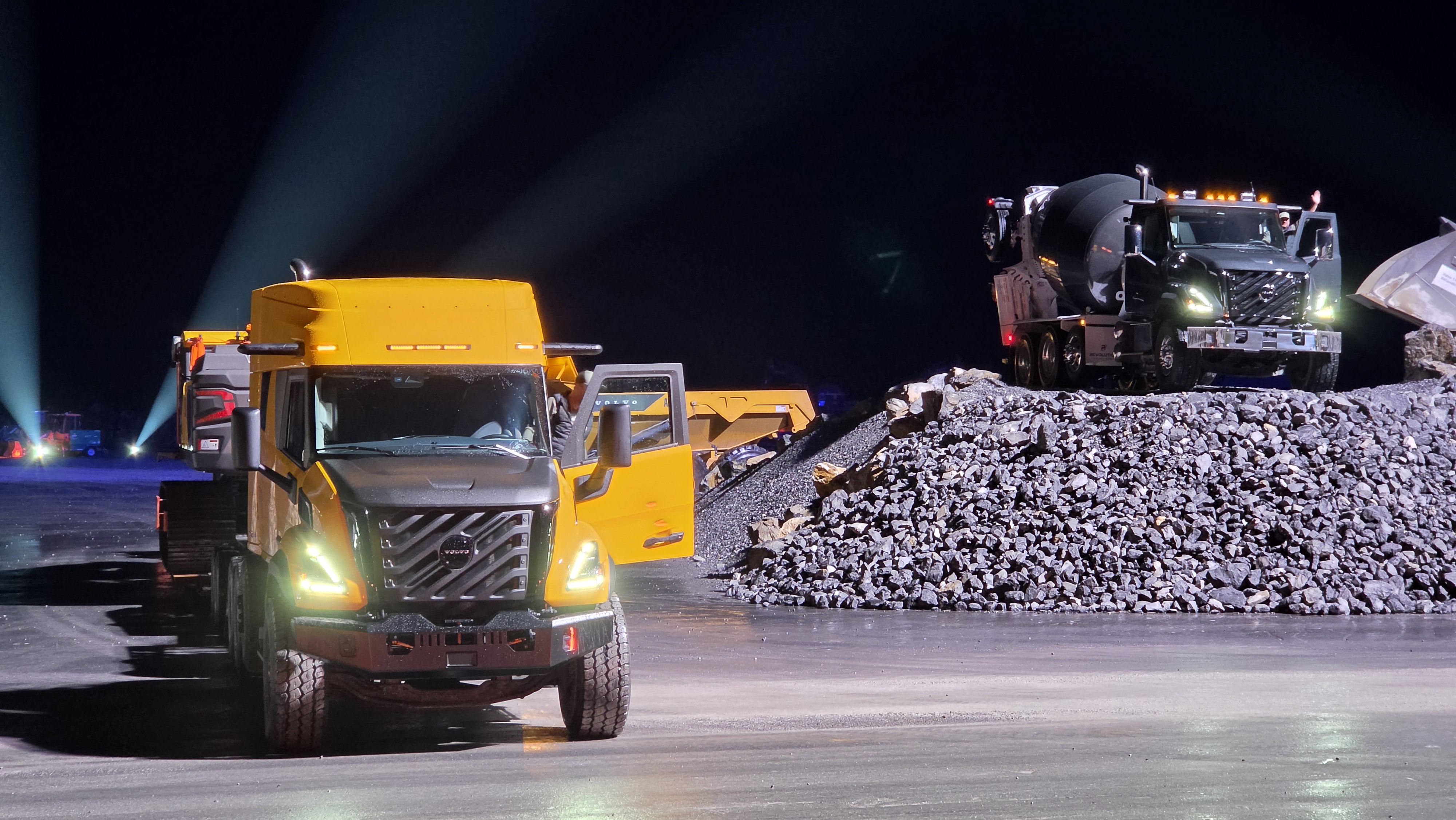
From remote-control steering to a hidden Easter egg in the dashboard, Volvo's new heavy-duty vocational truck has some surprises. I got to drive it, meet the people who designed it, and see what makes it different.
When I was growing up in Poland in the 1980s, I used to sit by the road near my grandmother's house watching big Volvo F12 trucks drive past. Those colorful trucks coming from Western Europe fascinated me. I spent hours drawing them, imagining what it would be like to drive one someday.
Fast-forward about 40 years, and I'm standing at the world premiere of the all-new Volvo VNX, talking to the engineers and designers who created it. I even got to drive the truck before its official reveal.
That was pretty special.
But beyond my personal experience, I came away genuinely impressed by what Volvo is trying to accomplish with this new truck.
Because the VNX isn't just another redesigned highway tractor. It's Volvo's latest attempt to become a much bigger player in some of the toughest trucking applications in North America.
And after seeing it in action, I think there's a lot worth talking about.
Volvo Wants a Bigger Piece of the Vocational Market
Most American truck drivers associate Volvo with highway trucks. The VNL is a familiar sight on our interstates, and the newer VNR serves regional applications.
But Volvo has been building trucks for construction and vocational work around the world for decades.
In Europe, the Volvo FMX is a familiar machine on construction sites. And here in North America, Volvo already offers the VHD.
So the new VNX doesn't mean Volvo is suddenly entering the vocational market. It means the company wants to compete in a much bigger part of it.
I asked Peter Voorhoeve, president of Volvo Trucks North America, why the company decided to expand its vocational lineup.
He pointed out that vocational trucks account for roughly 25% of the North American market.
That's a significant opportunity.
The new VNX is designed to serve a much wider range of applications, from heavy equipment transportation to concrete mixers, dump trucks, side dumps and other specialized work.
And that's one of the first things that caught my attention at the event.
We weren't looking at just one truck. We were looking at several very different machines built around the same new platform.
One Truck Family, Many Different Jobs
The all-new VNX is offered in different configurations to suit different applications, including day cab and sleeper models.
The lineup includes the VNX 300 day cab, VNX 440 with a 42-inch sleeper, and VNX 640 with a 62-inch midroof sleeper.
Customers can also choose configurations suited to different axle and body requirements.
Why does that matter?
Because a truck pulling a lowboy trailer with an excavator has completely different needs from a concrete mixer operating on a muddy construction site.
One needs to handle enormous combination weights on the highway. Another needs to maneuver around workers, equipment and tight spaces, often on uneven ground.
At the event, I watched a VNX hauling heavy equipment and another operating a side-dump trailer. The side dump could be controlled from inside the cab, allowing the operator to unload without climbing out.
It's a good example of how much specialized equipment can be integrated into a modern vocational truck.
Designed for the Companies That Finish Building the Truck
One of the most interesting conversations I had was with Volvo's exterior design team.
When we think about truck design, we usually think about the hood, grille, headlights and cab.
But on a vocational truck, what happens behind the cab can be just as important.
The companies that install mixer bodies, dump bodies, cranes and other equipment are called bodybuilders.
And they need space.
They need access to electrical connections, hydraulic systems and mounting points. They also need a chassis that doesn't make every installation unnecessarily complicated.
Brian, one of the designers behind the new VNX, explained that Volvo worked directly with bodybuilders during development.
The result is a cleaner area behind the cab, with provisions intended to simplify installing specialized equipment.
That might not sound exciting compared with a new engine or a remote control, but imagine building hundreds of trucks for a construction fleet.
If each installation takes less time and requires fewer modifications, that can make a real difference.
A D13 Engine With Up to 540 Horsepower
The new VNX is powered by Volvo's D13 diesel engine, offering up to 540 horsepower and 1,950 lb-ft of torque.
Those are serious numbers.
But horsepower and torque aren't the same thing.
Horsepower helps determine how much work an engine can do over time, including maintaining speed under load.
Torque is the twisting force produced by the engine. Combined with the transmission and axle gearing, it's especially important when getting a heavy load moving.
And that's exactly what a truck like this needs.
The new VNX also offers engine braking rated at up to 630 braking horsepower.
That's important when you're controlling a heavy truck on a long descent. Engine braking helps manage speed and reduces the amount of work the service brakes have to do.
Of course, the engine numbers alone don't tell us how much weight a truck can legally or safely haul. That depends on the complete configuration, including axles, gearing, brakes, tires and approved weight ratings.
Volvo says the VNX's heat-treated frame rails are rated for up to 160,000 pounds of gross vehicle weight. That's a frame-related rating, not a blanket claim that every VNX can pull a particular trailer weight.
The real test will be how the entire powertrain and chassis perform under demanding everyday conditions.
What Did an Actual Heavy-Haul Driver Think?
At the event, I spoke with Douglas Fraser of Lucky Banana Heavy Haul.
Douglas normally drives a 2019 Peterbilt 389 with an 18-speed manual transmission. In other words, he's accustomed to a very different kind of truck.
He drove the new VNX with a heavy load and came away impressed by how smoothly it accelerated and shifted.
He told me the truck didn't struggle to get moving.
But he also raised something I think many owner-operators will relate to.
Modern trucks have a lot more technology, electronics and sensors. That's great when everything works, but what happens when something breaks?
It's a legitimate concern.
For somebody who makes a living with a truck, reliability, repair costs, fuel consumption and downtime matter more than how impressive a machine looks at its world premiere.
Douglas also pointed out that even small fuel savings can make a difference because that money stays in the operator's pocket.
I think that's the right way to judge this truck.
Not just by how it drives during a demonstration, but by how much money it can help an operator earn or save over several years.
Remote Steer: A Full-Size Truck With a Remote Control
This was probably the most entertaining technology demonstration of the entire event.
Volvo let me operate the VNX from outside the cab using a handheld remote control.
Yes, a full-size truck.
Remote Steer allows an operator to maneuver the vehicle at speeds of up to 5 mph while standing outside.
Think about positioning a truck on a construction site where visibility is limited or where the driver needs to see exactly how close the vehicle is to an obstacle.
Instead of repeatedly climbing in and out of the cab, the operator can stand in a better position and carefully move the truck.
It's not autonomous driving. A person is still controlling the vehicle.
And I got a very memorable lesson in how much attention that requires.
I managed to get a little too close to a pile of rocks.
The event announcer joked that he thought I was about to become the first person to hit something.
Fortunately, I didn't.
The audience even gave me a round of applause.
It was funny, but it also demonstrated why precise low-speed control matters around expensive equipment and crowded jobsites.
Terrain Brake: A Small Feature With a Big Purpose
Another feature that caught my attention was Terrain Brake.
John Moore from Volvo explained how it works.
In the intended operating conditions, when the driver releases the accelerator, the system applies the brakes to help stop the truck from rolling unexpectedly.
Imagine inching a heavily loaded truck around a construction site, working on uneven terrain, or repeatedly moving forward and backward while positioning equipment.
You don't always have the luxury of a perfectly flat surface.
Terrain Brake is designed to make those low-speed maneuvers easier and more controlled.
The VNX also offers a feature to simplify changing direction during repetitive forward-and-reverse operations.
These aren't necessarily features that will impress someone looking at a truck in a dealership parking lot.
But for an operator who spends all day maneuvering around a jobsite, they could be genuinely useful.
Volvo Dynamic Steering: Less Fighting With the Wheel
Volvo Dynamic Steering is another technology that makes more sense once you understand the working conditions.
A heavy truck moving over rocks, ruts and uneven ground can transmit a lot of force back through the steering system.
That means the driver is constantly correcting the wheel and dealing with bumps and kickback.
Volvo Dynamic Steering uses an electronically controlled assistance system to help reduce steering effort and unwanted feedback.
It can also make low-speed maneuvering easier.
John made a point during our conversation that stuck with me: a truck can be tough enough for construction work without beating up the driver.
I agree.
There's no reason a modern vocational truck should have to be uncomfortable just because it works in rough conditions.
A Tough Truck Doesn't Have to Feel Like an Old Truck
One of the biggest surprises for me was how quiet and comfortable the VNX felt inside.
I've spent plenty of time around older trucks, and vocational equipment has traditionally prioritized durability over comfort.
But drivers today expect more.
Think about it. Somebody can drive to work in a modern pickup truck or SUV with comfortable seats, cameras, advanced safety systems and a quiet interior.
Then they climb into a work truck where they'll spend the next 10 or 12 hours.
Why shouldn't they expect a similar level of comfort?
I spoke with Jason Dable, the chief designer responsible for the VNX interior, and he explained how much attention went into the cab.
Everything from the placement of controls to removable cup holders and storage was studied and tested.
Volvo builds physical mockups and repeatedly refines the design before settling on the final layout.
The new cab shares its modern design philosophy with the latest VNL and VNR.
And the quietness was noticeable.
Douglas, coming from his old-school Peterbilt, noticed it too.
That matters for more than comfort.
Less noise, less vibration and easier steering can make a long workday less tiring.
And in an industry where companies struggle to attract and retain experienced drivers, the cab environment is becoming an increasingly important part of the equipment decision.
The Hidden Easter Egg Inside the Volvo VNX
One of my favorite details wasn't a big technological innovation. It was something most drivers might never even notice.
When I asked Jason about his favorite feature, he told me about a little Easter egg hidden in the dashboard design.
In the optional Edge interior trim, the texture on top of the dashboard is made up of tiny arrowheads.
And here's the interesting part: those arrowheads point in the same direction as the arrow on Volvo's famous Iron Mark logo in the center of the steering wheel.
It's such a small detail that you could drive the truck for years without noticing it.
Jason told me he likes those little hidden touches and hopes that someday a driver will discover one while working on a job site.
I love that.
When you think about developing a new truck, you imagine engineers worrying about engines, transmissions, safety systems and thousands of other technical challenges.
But somewhere along the way, a designer was also thinking about the direction of tiny arrows on the dashboard.
As someone who grew up drawing Volvo trucks, I find that fascinating.
It shows how much thought goes into designing these machines, including details that have absolutely nothing to do with horsepower, payload or fuel economy.
Sometimes, the smallest details tell you the most about the people who designed something.
Safety on a Construction Site Is Different From Safety on the Highway
Volvo has built much of its reputation around safety, and the VNX brings that focus into an environment where the risks can be very different.
On a highway, you're primarily dealing with traffic moving in the same direction.
On a construction site, you might have workers walking around the truck, excavators swinging nearby, loaders moving in reverse, uneven ground and equipment blocking your view.
The VNX incorporates a high-strength steel cab structure, available active safety technology, camera and detection systems, and side curtain airbags.
But one of the most interesting safety features I saw was actually the windshield.
A Windshield That Can Take a Beating
Volvo calls it Tough Shield.
At the event, they had a demonstration where an air cannon fired ice balls at the windshield.
And they let me push the button.
According to Volvo, Tough Shield offers twice the resistance to sharp impacts and thermal shock compared with tempered glass, along with five times the scratch resistance of a standard windshield.
Those are different performance measures, so I wouldn't simply call it five times stronger than ordinary glass.
But the concept makes sense.
Construction trucks frequently operate around gravel, rocks, debris and equipment that can damage a windshield.
A more durable windshield could mean fewer repairs, less downtime and better visibility over time.
I'm looking forward to seeing how it performs after years of real-world use.
Swedish Brand, American Engineering and Manufacturing
Here's something that might surprise people who still think of Volvo as simply a Swedish truck manufacturer.
The new VNX was developed for North American customers, with design and engineering work taking place here in the United States.
Volvo assembles its North American trucks at its New River Valley plant in Dublin, Virginia, while its engine manufacturing operations are in Hagerstown, Maryland.
I spoke with Cecilia Carlsson from Volvo Trucks North America, who emphasized that the company doesn't just assemble trucks here.
Its teams work directly with North American customers, learn about their applications, and use that feedback in product development.
That's important because construction and heavy-haul requirements can vary considerably between markets.
An American vocational truck needs to work with the equipment, regulations, service networks and operating practices found here.
The VNX also builds on Volvo's newer North American truck platform, which has already brought major redesigns to the VNL and VNR.
Rather than developing every new model completely independently, Volvo can use shared engineering, components and technology while adapting each truck for its particular job.
That can create advantages in manufacturing, parts commonality and service support, although the real benefits will become clearer as the new trucks enter operation.
More Than Just Another Truck Reveal
For me personally, this event was memorable for reasons that go beyond horsepower and technology.
I got to operate excavators, watch massive construction machines at work, nearly drive a truck into a pile of rocks with a remote control, and meet the people who created the new VNX.
But one of my favorite moments was talking with the designers.
When I was a kid drawing Volvo trucks in Poland, I never thought about the engineers and designers who were making those machines possible.
Now I understand how much work goes into every detail, including things most drivers will probably never notice.
That's what fascinates me about modern trucks.
They may still look like familiar machines from the outside, but underneath, the technology keeps evolving.
And after seeing the new VNX, I have a feeling the competition in the North American vocational market is about to get even more interesting.
Watch my full Volvo VNX reveal video on CKDrive.com, featuring exclusive driving footage, technology demonstrations and conversations with the people behind the truck.
Chris Kuna | CK Drive
.png)