The engine has become simpler while the fuel economy gets higher. It should dramatically reduce the parked regen number. If you try to run— get run over by this truck, it will not let that happen. I mean, don't try it at home.
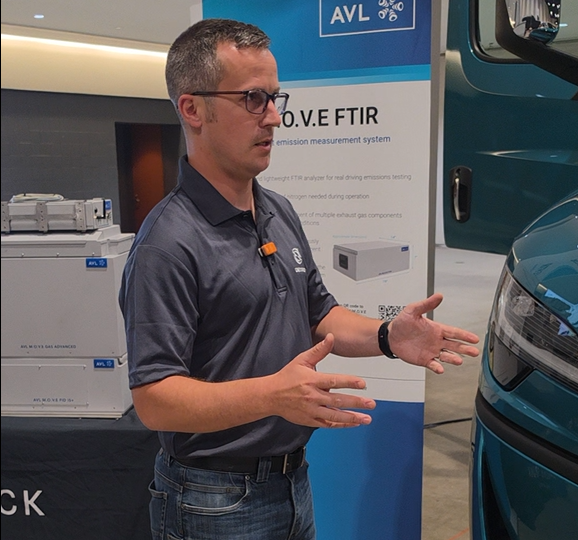
My name is Dominic. I am a vehicle test engineer for Detroit. What are the major differences between the Gen 6 and Gen 5? There's a lot.
Many, many small things. A couple of the bigger things that are notable is it's an all-new fuel system. We simplified the fuel injection system. The injector is not amplified anymore, so which removed a lot of internal parts in the injector and we expect that, I mean we know because we've done a lot of testing, but we expect that to be a lot more robust, work better for the customer.
There's a new aftertreatment system also that comes with that engine that meets the EPA 27 reg. We've been able to use existing technologies in a new way on this aftertreatment to meet the reg. The customers will be seeing technology that they're used to. Anything in the engine camshaft design?
Yeah, yeah, there's a new camshaft.
So it's a Miller cam. The Miller cycle basically, you can, we can talk about this for hours, but very simply, you know, it hangs the exhaust valve open just a little bit longer and it allows for more efficient combustion. Are the turbo VGT, no VGT?
No VGT. Yeah.
So it's, it's a fixed turbo, simple components, proven technology.
So for an end user, fleet owner or an owner operator, basically what does that translate to?
Better fuel economy, reliability, less maintenance costs? Yes. I mean, yes to all 3. Yeah.
We're seeing better fuel economy. The engine has become simpler while the fuel economy gets higher. To meet the EPA 27, some OEMs elected to go with the electric heater. Any changes with the aftertreatment system here for the 2027 model year?
So there's no electric heater on this for '27. We were able to use, it's a pre-SCR, so it's again the same technology that you have from the previous generation. Just there's an additional SCR and then we have a dual dosing.
So again, but these are the same parts.
So you've got regions, spark regions. We're expecting to really not see I don't wanna say none, but very close. It should dramatically reduce the parked regen number.
In some applications we had an exhaust flap or a thermal control valve we call it.
So in the Gen 6 engine they all have that.
Okay. And our engineers love this thing because it allows us to get engine temp up immediately. It's an awesome knob that they can turn to make the calibration perform better when that valve is in action.
It can really reduce the amount of times that you have to do a parked regen. I mean, we're doing passive regen almost exclusively on the Gen 6.
So for a normal highway operation, you should not ever— That's right.
Okay.
That's pretty cool. It's pretty nice. Yeah. Drivers have been complaining about this on the older generations.
Any false positives, unnecessary braking, any improvement here? Any AI involved in analyzing of that data from— Not on the truck any, but there is a pretty massive improvement. The, the whole electronic architecture behind all of this has been massively updated.
So we have CAN FD, automotive Ethernet, and this allows for much more communication traffic between the radar and the rest of the truck.
For the lane keep assist, you can select the drive— and this is driver selectable on the steering wheel with like 2 button clicks— you can choose if you're gonna be predominantly in the center of the lane, the right side of the lane, or the left side of the lane. And in a passenger car, that might not matter, but as We all truck drivers know when I'm on the right side, I like to keep my right side tires on the fog line, right, so that you leave more room for traffic next to you. Well, you can do that here.
So I can say, oh hey, shift over to the right, and then now I'm not fighting that wheel all the time.
It's going to just favor the right side. This is a new thing. Yes, here on the side we have Side Guard Assist on both sides.
So this is blind spot detection and it reaches all the way back to the end of the trailer.
You got that on both sides, and then that works in conjunction with additional radar that is under the headlight.
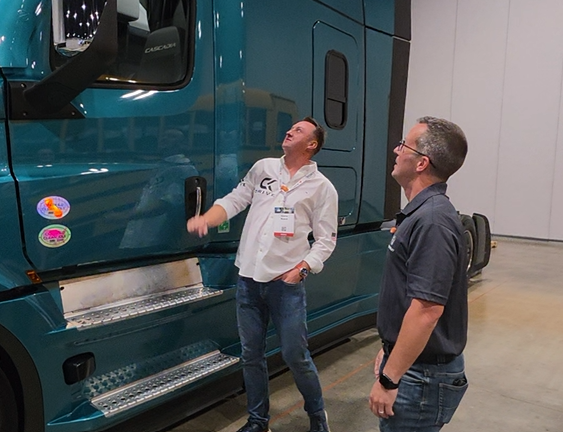
So we're looking— we got pedestrian detection. Tested this myself, uh, walking around in a parking lot with a truck. If you try to run— get run over by this truck, it will not let that happen.
I mean, don't try it at home. I'm not encouraging that. I'm just saying. But it works.
We have tested it. You're still here with us. I am still here.
.png)

.png)

.png)