One of the things that fascinates me most about modern trucks is how normal they can look from the outside.
Put a new Freightliner Cascadia next to one from several years ago and, unless you really know what you are looking at, the basic shape still feels familiar. It is still a conventional Class 8 truck. It still has a diesel engine, a transmission, axles, mirrors, a sleeper and a steering wheel.
But underneath that familiar shape, the truck has changed enormously.
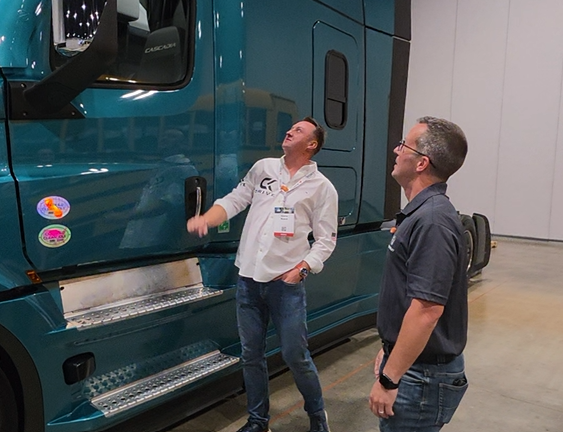
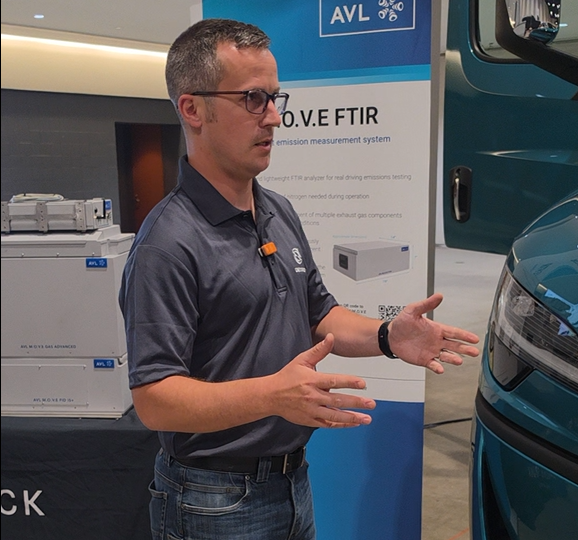
After talking with Dominic, a vehicle test engineer with Detroit, that is what stuck with me most. Engineers are never really allowed to finish a truck. The moment one generation reaches production, they are already working on the next one.
And they are being pushed from every direction.
Regulators want lower emissions. Fleets want better fuel economy and lower maintenance costs. Drivers want more comfort, better visibility and safety systems that actually help instead of annoying them. And manufacturers still have to build a machine that can run hundreds of thousands of miles in one of the harshest working environments imaginable.
That is a difficult balancing act.
The pressure on Freightliner is enormous
There are roughly 3.7 million Class 8 trucks operating in the United States, based on widely cited industry figures. American Trucking Associations
Freightliner sits at the center of that market. In June 2026, Freightliner accounted for 35.6% of U.S. Class 8 sales, according to Omdia data reported by Transport Topics. Transport Topics Daimler Truck, which combines Freightliner and Western Star in its North American reporting, held 39.6% of the North American Class 8 market in 2025. Daimler Truck
That means changes coming out of Detroit and Freightliner are not affecting some small corner of the trucking industry. They affect a huge number of fleets, owner-operators and drivers.
And when you have that much market share, there is nowhere to hide.
If the truck gets better fuel economy, fleets notice.
If it spends too much time in the shop, fleets notice.
If the safety systems brake when they should not, drivers notice.
If the cab is uncomfortable, drivers notice.
Every engineering decision gets tested in the real world by thousands of people who depend on these machines to make a living.
Engineers have two customers now
Historically, it was easy to think about truck development mostly in terms of the fleet owner.
Does it make money?
Is it reliable?
How much fuel does it burn?
How much does it cost to maintain?
Those questions are still extremely important. But now the driver has become a much bigger part of that equation.
Driver retention is a real business problem. A fleet can buy the most efficient truck in the world, but if drivers hate spending 10 or 11 hours a day inside it, that truck can create another problem.
Drivers today are also comparing their work truck with their personal vehicle.
They get into their car and have adaptive cruise control, lane assistance, blind-spot monitoring, excellent climate control, quiet interiors, cameras and increasingly sophisticated infotainment.
Then they climb into the machine where they spend most of their working life.
Naturally, they expect some of the same things.
That is why features that once might have sounded like luxuries are increasingly becoming part of the competitive equation.
In the Cascadia, Dominic showed me a lane-keeping system that can favor the center, left or right side of the lane. For a truck driver, that is not just a technology demonstration. A driver might want to stay closer to the fog line to create more space from traffic on the left. In construction, the preference can be moved the other direction.
That is a small feature on paper.
After thousands of highway miles, small features matter.
At the same time, the engine has to get cleaner
Then there is the other side of the equation: emissions.
EPA's heavy-duty engine standards become more stringent beginning with model year 2027, including tighter limits on pollutants such as NOx across a wider range of engine operating conditions. US EPA The regulatory framework is still evolving — EPA proposed additional amendments to some 2027 compliance provisions in 2026 — but manufacturers have already spent years engineering engines and aftertreatment systems around the new requirements. US EPA
The interesting part of Detroit's approach is that, at least from what Dominic showed me, the answer is not simply to keep adding more and more exotic hardware.
In some areas, they are doing the opposite.
The new Gen 6 DD15 uses a simplified fuel injection system. Detroit moved to a fixed turbo rather than a variable-geometry turbo. The engine uses a Miller-cycle camshaft to improve combustion efficiency.
For the 2027 aftertreatment system, Dominic explained that Detroit is largely using technologies customers already know — SCR, additional dosing and thermal management — but arranging and controlling them differently.
That caught my attention.
New regulations often create fear that the next generation of diesel engines will become even more complicated. Detroit's answer appears to be: meet the regulation, but simplify where you can.
That is exactly what fleets have been asking for.
The regen question may matter more than almost anything else
Ask a driver or owner-operator what they think about modern emissions equipment and the conversation usually gets to regeneration pretty quickly.
A parked regen is not an interesting engineering event when you are trying to deliver freight.
It is downtime.
Dominic told me Detroit expects the Gen 6 system to rely heavily on passive regeneration during normal highway operation. An exhaust thermal control valve helps bring temperatures up quickly, allowing the aftertreatment system to do more of its work while the truck is operating.
If that translates into dramatically fewer parked regens in the real world, drivers and fleets are going to notice.
But that last part matters: in the real world.
Manufacturers can test trucks for millions of miles. Engineers can model temperatures, emissions, fuel consumption and component life. But trucking has a way of finding conditions a laboratory cannot perfectly recreate.
Extreme cold.
Extreme heat.
Long idle periods.
Short routes.
Mountain grades.
Poor maintenance.
Different duty cycles.
A truck that performs beautifully in one operation may live a completely different life in another.
That is why I am interested in seeing what happens once these engines begin accumulating serious mileage in customer hands.
The truck is getting simpler and more complicated at the same time
There is almost a contradiction happening in modern truck design.
Mechanically, manufacturers are searching for simplicity.
Electronically, trucks are becoming much more sophisticated.
Dominic talked about a new electronic architecture, faster communication between systems, improved radar, blind-spot detection, pedestrian detection and more advanced lane assistance.
Some of that development is responding directly to driver complaints.
False braking is a perfect example.
It does not matter how impressive an automatic emergency braking system is on a PowerPoint presentation if drivers lose trust in it because it reacts when it should not.
The technology has to work well enough that the driver stops thinking about it.
That may be one of the hardest standards engineers have to meet.
We usually see the truck. We do not see the engineering race underneath it.
That is what I came away thinking about after this conversation.
We tend to talk about trucks as individual models: Cascadia, VNL, T680, 579.
But each new truck is really the result of several competing forces pushing against each other.
Lower emissions.
Better fuel economy.
Higher reliability.
Lower maintenance costs.
More safety technology.
More driver comfort.
And somehow the manufacturer has to improve all of them without making the truck unaffordable or impossible to repair.
Freightliner has an especially difficult job because of its scale. When you control more than a third of the Class 8 market, every major engineering decision is multiplied across an enormous fleet.
The Gen 6 DD15 looks promising to me for one reason in particular: the philosophy seems sensible.
Use proven technology where it still works.
Simplify components where possible.
Improve thermal management instead of simply adding complexity.
Make the electronic systems smarter.
And keep listening to the people who actually drive and maintain the trucks.
Whether the 2027 engine delivers on those promises is something we will only know after fleets put serious miles on it.
For now, I find it fascinating that a truck can look so familiar from the outside while underneath, engineers are continuously redesigning almost everything.
.png)

.png)

.png)