[00:00] Stop me at this point in my presentation and say, you've just saved me $10,000 of operating expense in 6 years.
[00:08] My name is David Hillman.
[00:09] I'm VP of Integrated Technology Sales at International.
[00:12] What is this beauty behind us here?
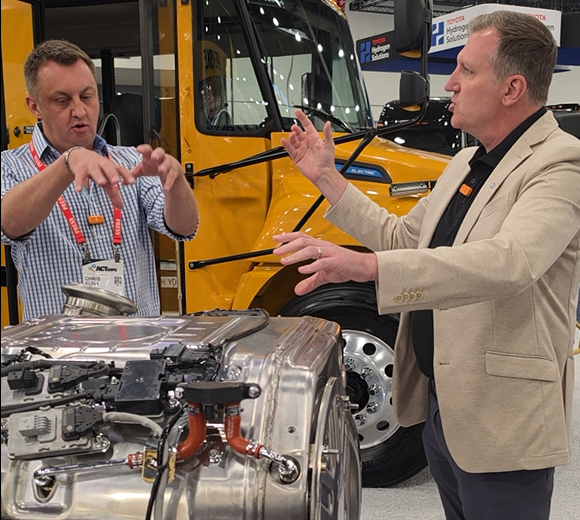
[00:14] What we have on display in our booth is our 2027 hardware set for the new low NOx emissions coming January 1st, 2027.
[00:24] Some of your viewers may know that we introduced the S13 here in the United States and Canada markets and Mexico.
[00:32] In the North American markets in late 2023.
[00:35] So this is an evolution of that product.
[00:39] 90% of what we've been building for the last 3 years will carry over into the 2027.
[00:44] I've heard some exciting stuff, but very mysterious sounding stuff.
[00:48] Okay.
[00:48] No EGR.
[00:49] Yes.
[00:49] No variable turbo.
[00:51] On the hot side of the engine, what we don't have, we don't have an EGR cooler.
[00:55] What is an EGR?
[00:56] Takes exhaust gas from the exhaust stream, loops it back around to the front side and reintroduces it into combustion.
[01:03] So hot it becomes a combustor.
[01:03] Goes to the turbo first?
[01:05] No, no.
[01:06] Think of it this way: there's a fork in the road.
[01:08] Some of it goes— most of it would go to the turbo, but call it around 15 or 20% would go through a cooler back to the front side and be reintroduced into the combustion.
[01:19] You do that to reduce knocks in cylinder.
[01:22] One of the common themes that we all shared was a recognition that EGR coolers were sort of a weak link in the chain, and if you want to make a stronger chain, design out your weakest link.
[01:34] So we designed the EGR cooler off the engine.
[01:38] So when the drivers say, or owner-operators say, that all the new engines, new technology is worse than what it used to be, EGR would be one of the components that would— EGR is typically something that has been a source of frustration for customers for many years.
[01:54] So now it's out.
[01:54] So now it's out.
[01:55] We designed that off.
[01:56] Okay.
[01:57] We're telling the engine to do what the engine wants to do, make power.
[02:00] That's what engines do best.
[02:02] We're also able to simplify the turbo system.
[02:04] Okay.
[02:05] The reason why is we're not We're not siphoning off 15% or 20% of the exhaust and recirculating it.
[02:13] 100% of the exhaust energy hits the turbine wheel, which means we can simplify the turbocharger.
[02:19] 100% of the exhaust energy with the S13 goes to the turbo, so therefore we could simplify the turbo.
[02:25] So variable geometry turbos work, and we've used them for many years in other engine designs ourselves, but they tend to also be a bit finicky.
[02:35] It's a source of complaints for some applications.
[02:37] So another weak link.
[02:38] Another weak link.
[02:40] So we've hit 2 weak links.
[02:41] I've had customers stop me at this point in my presentation and say, you've just saved me $10,000 of operating expense in 6 years.
[02:51] That was my next question.
[02:52] How does it affect the truck driver, owner-operator, or a small fleet owner?
[02:56] So a lot of it is going to depend on the application and the duty cycle.
[03:02] But I would say a lot of customers will tell us facts like that, that, hey, in the first 6 years of owning, of owning my vehicle, I will replace 2 EGR coolers and 1 variable geometry turbo, and they do the math in their head.
[03:15] So I don't want to give them my numbers.
[03:17] I let them play to me what numbers they use, and the $10,000 number is one that I've heard on more than one occasion.
[03:24] When I'm doing a walk-around, I'll pull up the truck and I'll tilt the hood, and I look for the people with steel-toed shoes that, that work on trucks for a living, and I show them the hot side of the engine, and they love how simple it looks because you can actually see the block itself.
[03:40] You can see the engine.
[03:42] It's not covered with an EGR cooler and a lot of associated piping and things like that.
[03:48] Less complicated.
[03:49] Yes.
[03:49] Less downtime.
[03:50] Correct.
[03:51] More miles for the drivers, less headache for the owner.
[03:55] It's geared towards simplification because that helps with uptime and reliability.
[04:02] We still have to control the NOx output, right?
[04:05] So the 2 primary tailpipe criteria pollutants that we're obligated to control by the EPA are NOx and particulate matter.
[04:16] The other word for particulate matter is soot, but it's effectively unburned diesel.
[04:24] Soot increases when you have dead air inside.
[04:27] So those EGR coolers, that had the effect of reducing NOx, but it increases your particulate matter.
[04:35] So the S13 has that benefit of simplifying the design but also since NOx is so high, we're burning very completely.
[04:45] There's very little soot generated.
[04:48] So you still perform regen here or no?
[04:50] There are no active regens.
[04:52] Okay.
[04:52] We have parked regens just which help increase the heat in the catalyst, but at no point are we putting diesel in the aftertreatment module.
[05:02] So there are no active regens.
[05:04] And it's even better for 2027.
[05:06] The most important thing that I like to convey about our 2027 solution is that 90% of the hardware carries over from what we're building today to what we need to meet the regs.
[05:16] We did not have to go through a real revolution.
[05:19] We designed with future regs in mind, so that's why 90% of our components carry over.
.png)

.png)

.png)