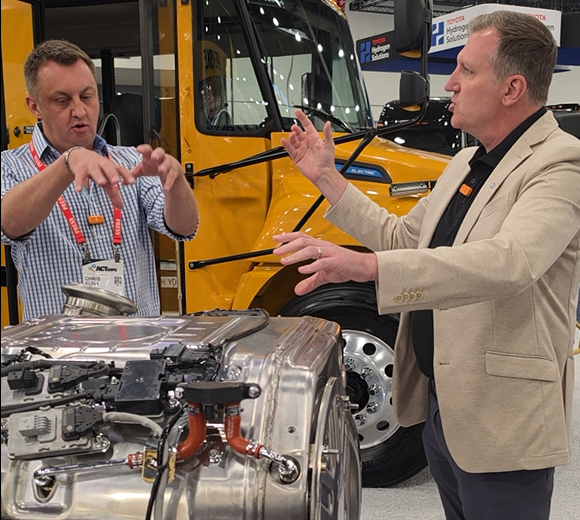
I think I learned more about EGR, aftertreatment and finicky turbos in five minutes with David Hillman than I have in my entire life around trucks.
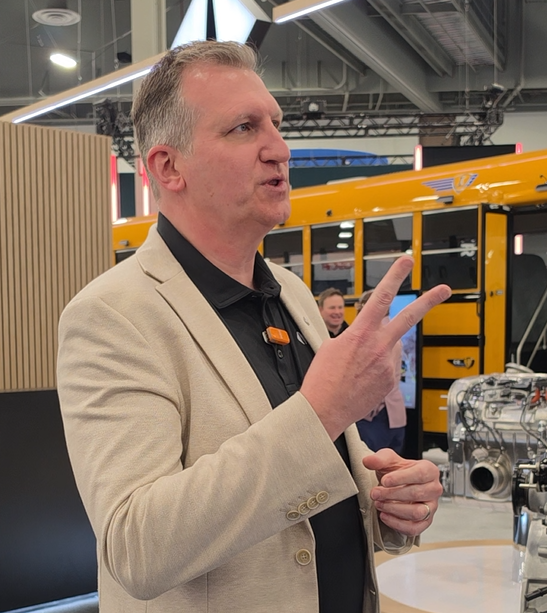
David is VP of Integrated Technology Sales at International, and our conversation about the S13 helped connect a few dots for me.
We hear a lot about emissions regulations and new diesel technology. Usually, that means adding more equipment, more sensors and more complexity to a truck.
International went in an interesting direction with the S13: they took some things away.
And after talking to David, I understand why that matters to the person actually paying to operate the truck.
Why Get Rid of the EGR Cooler?
EGR stands for exhaust gas recirculation.
In simple terms, an EGR system takes some of the exhaust coming out of the engine, cools it and sends it back into the combustion process. The purpose is to reduce NOx produced inside the engine.
It works, but there is a tradeoff.
EGR coolers and all the related plumbing add complexity. And anyone who has owned or maintained modern diesel equipment probably knows that EGR systems haven't exactly earned a reputation for being everyone's favorite part of the truck.
David described the EGR cooler as one of the "weak links in the chain."
International's engineers decided to design that weak link out of the S13.
Instead of asking the engine to reduce NOx through EGR, the S13 is allowed to concentrate more on what a diesel engine does best: efficiently making power. The emissions system downstream then has to do more of the work of controlling NOx before it reaches the tailpipe.
That leads to another interesting change.
No EGR Also Means a Simpler Turbo
When an engine uses EGR, some exhaust is diverted away and recirculated.
Without that system on the S13, David explained that 100% of the exhaust energy can go toward the turbine wheel.
That allowed International to simplify the turbocharger and avoid using a variable geometry turbo.
Variable geometry turbos are impressive pieces of engineering. They can adjust their geometry to perform effectively across different engine speeds.
But as David put it, they can also be "a bit finicky."
So now we have two complicated components removed from the equation: the EGR cooler and variable geometry turbo.
That's where this stopped being just an interesting engineering conversation for me and started becoming a business conversation.
Simpler Can Mean Less Money Spent in the Shop
David told me that customers have stopped him during presentations and told him that eliminating those components could save them around $10,000 over six years.
That's not an International guarantee, and David was careful not to present it as one.
Actual costs depend on the truck, application, duty cycle and what repairs that particular vehicle would otherwise experience. His example came from customers doing their own math based on potentially replacing EGR coolers and a variable geometry turbo during their ownership cycle.
But the basic idea makes sense.
If a component isn't on the engine, it can't fail.
It can't put the truck in the shop. You don't have to buy a replacement. You don't have to pay somebody to install it. And the truck doesn't lose productive time because of that particular component.
For a single owner-operator, that matters.
Multiply it across 50, 500 or 5,000 trucks and simplifying the powertrain becomes a much bigger business decision.
But You Still Have to Deal With the Emissions
Of course, removing EGR doesn't mean emissions regulations disappear.
The engine still has to meet the required tailpipe limits.
This is where the S13's aftertreatment strategy becomes interesting.
David explained that the engine is designed to burn very completely, producing very little soot. The tradeoff is that NOx has to be addressed downstream through the aftertreatment system.
That distinction finally made the whole system click for me.
Instead of trying to solve as much of the NOx problem inside the engine with EGR, International is allowing the engine and aftertreatment system to specialize in different jobs.
The engine makes power efficiently.
The aftertreatment handles the emissions.
There is obviously much more engineering happening behind those two sentences, but from an operator's perspective, that's a pretty easy way to understand the philosophy.
David also explained that the system doesn't use diesel dosing in the aftertreatment for active regeneration. He said there are no active regens, although parked regens can still be used to increase catalyst temperature.
Again, less complexity and less diesel being used for something other than moving the truck.
Then Came the Part About 2027
The timing of this conversation was especially interesting because another round of EPA heavy-duty emissions requirements takes effect in 2027.
Whenever new emissions rules arrive, one of the first questions from the trucking industry is predictable:
What new equipment are we going to have to put on these trucks now?
That's why something David said toward the end of our conversation stood out to me.
According to him, approximately 90% of the hardware International is using today carries over into its 2027 solution.
International didn't have to completely reinvent the S13 to prepare it for the next emissions standard. David's explanation was that the engine was developed with future regulations already in mind.
For fleets, that could be an important part of the story.
New emissions regulations are one thing. An entirely new and unproven powertrain is another.
If International can meet the new requirements while retaining most of an architecture fleets are already operating, that could make the transition less intimidating.
Of course, the real test will always happen on the road.
Reliability isn't proven on a trade show floor. It's proven after hundreds of thousands of miles, winters, summers, heavy loads, different duty cycles and thousands of trucks operating in the real world.
Will Other Engine Manufacturers Go the Same Direction?
That's the question I walked away with.
International's approach makes sense when David explains it: simplify the engine, remove components that have historically created maintenance concerns, let the engine concentrate on efficient combustion and move more of the emissions-control responsibility downstream.
But there is rarely only one way to solve an engineering problem.
Other manufacturers have their own engine architectures, emissions strategies, development histories and ideas about how to balance efficiency, reliability, emissions and cost.
So I'm curious to see whether International's approach represents a broader direction for heavy-duty diesel engines or whether the S13 remains distinctly different from what other manufacturers choose to do.
Either way, I came away from this conversation thinking about something we don't say very often when discussing modern trucks:
New technology doesn't always have to mean adding more stuff.
Sometimes the engineering advancement is figuring out what you can take away.
And if taking it away means fewer repairs, less downtime and more miles between trips to the shop, that's technology I think drivers and fleet owners can appreciate.
Watch my full five-minute conversation with David Hillman of International on CK Drive.
.png)

.png)

.png)