.png)

Fleet & Trucking
Autonomous & AI
Driver Comfort Is No Longer a Luxury. It Is a Competitive Advantage.
The future of trucking is not about replacing drivers. It is about giving them safer, smarter, and more capable tools.
July 26, 2026
Read More
.png)

© 2026 CK Drive. All rights reserved.
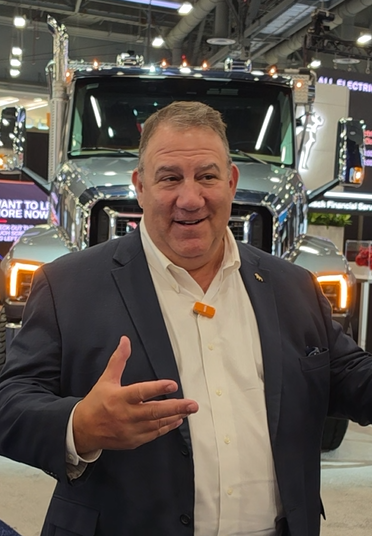
What does the future of trucking look like from the perspective of one of the industry's leading truck manufacturers?
In this conversation, Jonathan Randall, President of Mack Trucks North America, shares how Mack approaches truck design, driver comfort, safety, uptime, artificial intelligence, and the evolving role of professional drivers.
Rather than designing trucks around technology alone, Jonathan explains why Mack starts "from the driver's seat out," ensuring new innovations improve the experience for the people who operate these vehicles every day.
The discussion also explores predictive safety systems, driver retention, modern truck technology, and how commercial vehicles may continue evolving over the next several years.
• Mack designed its newest trucks from the driver's seat outward, prioritizing driver comfort, safety, and productivity.
• Professional truck drivers will remain essential to the supply chain despite advances in automation.
• Modern commercial trucks offer significant improvements in ride quality, fuel efficiency, safety, and connectivity compared to previous generations.
• Driver retention depends heavily on providing equipment drivers actually want to operate.
• Future AI systems will move beyond reacting to hazards and begin predicting dangerous situations before they occur.
• Uptime remains one of the most important factors for both fleets and drivers because parked trucks don't generate revenue.
• Jonathan Randall earned his own CDL and believes understanding the driver's perspective is essential for truck manufacturers.
We actually started the development of that truck from the driver's seat out. Trucks are not what they used to be, and by the way, that's a great thing.
So you got to give them the equipment that they want to drive. You got to give them equipment that's comfortable.
You got to give them equipment that's safe. It senses you're going into a turn too fast early on, so it starts to put the brakes on for you. Jonathan Randall, president of Mack Trucks for North America. My name is Chris.
Chris, good to see you. Very nice meeting you. Beautiful trucks behind us. They are gorgeous.
What is this and what's that?
So that's our all-new, brand-new Mack Granite. We actually launched it, I guess, about a month a month ago in Las Vegas.
So it replaces the iconic of the same name when we start building that next year.
So really excited about that. And right next to it?
Next to it right here, we've got our Pioneer.
So this is our new on-highway truck.
We introduced this bad boy a little over a year ago in Brooklyn, along with celebrating 125 years of Mack development and Mack— what's the word I'm looking for? That's a great word and I can't think of it. Mack innovation. Innovation.
Innovation. I don't know why that escaped me.
Anyway, so this, we started building this this year and it's been really well received by our customers.
Awesome.
Jonathan, I wanna ask you about the truck driver's perspective, the men and women, the hardworking men and women of America that actually get behind the wheel of these trucks. Sure. And put on the hard work. They do the dirty work, right?
They do.
Right now, the innovation, advancement, AI technology, everything is all about productivity and making money and profit margins. How does Mack use that human component? What does Mack do?
What is your philosophy to help the truck drivers, people behind the wheel? I think the first thing is when you talk about the, the money we invested in the development of this truck, uh, and the Anthem, and then what you see is the Granite, and then the sister of that, the Keystone, is we actually started the development of that truck from the driver's seat out.
Okay.
So really it was about the human-machine interaction on the driver, making sure that they could be as comfortable and as efficient and as safe as they possibly can be, right?
Because right now it's, you know, there continues to be a struggle to attract and keep drivers into the industry, and they're going to be for a long while and we're gonna need 'em for a long while.
So it's about giving them the things that are gonna help them succeed.
So you start there and the technology's part of that, right?
And so the driver comfort is the one thing, right?
Driver comfort, drive efficiency, and safety and uptime.
Okay, uptime.
Absolutely. If the wheel's not spinning, we're not making any money.
Truck's not earning, drivers are frustrated, they're down, they're not earning money and they're just stuck, right?
You know, the old school truckers say that trucks are not what they used to be, the new technology, there's just so many things to break down. What is the new technology? Is it really the case?
Trucks are not what they used to be. And by the way, that's a great thing, right? Right. We continue to develop the technology and the innovation.
They're safer than they've ever been. They're more smooth riding than they've ever been. The fuel efficiency is as good as it's ever been, and the comfort is as good as it's ever been.
And so what you're climbing into today versus what you were climbing into even 15 years ago is a sea change.
And so we're gonna continue to push the boundaries when it comes to technology when it comes to innovation to make sure that we're providing a piece of equipment that can be the most efficient, the most productive, and offer the best uptime along with the safety for the driver. Would you say that the younger drivers, the younger crowd, they're more demanding? They do want that connectivity, the technology, the nicer seats. They're certainly more familiar with it.
They're easier. They adapt to it easier than some of the, some of the tenured drivers. But I will tell you that if you take somebody who's been driving a truck for a long while, you put them in one of these new trucks, you can't pry them out without a crowbar.
So yeah, it's the adoption of the technology.
You can hem and haw about it, you can kick the can, whatever you want. The second you actually interact with it and you see what it can do for you, you embrace it. For fleet owners, it is a big issue, the driver retention, right? Or it's come and go.
For sure. How does Mack, whether the vocational trucks or the over-the-road application, how does that play a role in driver retention?
So you got to give them the equipment that they want to drive. You got to give them equipment that's comfortable.
You got equipment that's safe. You got to work with an OEM that when things break down, because they will, they're mechanical, eventually they're going to break down, you get back up and running on the road as quickly as possible, that there's a priority to making that happen. If you do that and you supply that kind of equipment to your drivers, you're going to retain them. And I wanted to ask you a little more personal question.
Sure. What's your story? How did you get into trucking, this business? Do you even have a CDL?
I do actually have a CDL. I've been driving trucks for a long while, but I figured I needed to make it official with my CDL.
So yes, I I do have a CDL. Started years ago in truck leasing and just happened to get into truck leasing and really enjoyed the business-to-business aspect of it.
And what I really like is you're helping solve problems for customers to be better suppliers to their customers, to solve problems, help them make more money, right? And you're making financial decisions, not really emotional decisions.
And so it's a great business-to-business, business-to-business business, I guess. Today's truck, adaptive cruise control, wireless charging, all the sensors.
Lane change assist. Yeah. What does a truck look like in 5 years from today? I don't know that the truck looks different.
I think the technology advances. I think it becomes more robust. And from that we can do things to even be more productive with the asset, maybe take the driver somewhat out of the actual driving experience. And from that, I mean, be able to do things for the driver that they've gotta focus on today, whether it's lane change or following too close or those kinds of things.
Things and where they can focus on just what they need to do, getting safely from point A to point B. Today's systems are very reactive.
Something happens on the road, the truck reacts faster than the human would have. Correct.
What is the role of the AI in the future in the truck? The whole point is, and maybe not the whole point, but when you talk about AI, it's going from reactive to predictive or reactive to proactive, right?
And so that it senses you're going into a turn too fast early on.
So it starts to put the brakes on for you already so that you don't, you don't turn over.
I mean, things like that are going to continue. Like there's an object on the road. Right. Or you're following too close or you're going too fast at this speed, at this distance, and there's braking ahead.
Right. And then it's just stopping, you know, putting the brakes on before you even think to put the brakes on.
So how does it translate to the advantage to the driver? Like how does the driver benefit from it?
They're safer. Less accidents, more safe, more efficient, less downtime. Jonathan, it was a pleasure. Thank you so much.
My pleasure. I really appreciate it.

The future of trucking is not about replacing drivers. It is about giving them safer, smarter, and more capable tools.
.png)