push up freight rates. And we haven't been able to say that for 4 years. Right, the driving part's easy. It's everything else you've got to do, running a business, dealing with traffic, dealing with shippers.
You really got to know your stuff as a flatbedder. That's a market that I think will always be specialized. Dry vans are hard to separate yourself from the pack. It's about time and distance.
The immigration side of it, and migrants have tended to go to where nobody else wants to be. Is it DAT or DAT? DAT is generally how we'd say it, yeah. Yeah, and what is your name and what do you do at DAT?
Dean Croak. I'm a market analyst. I'm a freight market analyst at DAT, or what used to be Dial-A-Truck. And I look after the carrier side of our network.
So I look at what rates are doing, what supply and demand's looking from a carrier perspective.
So you're the guy with the crystal ball? Yeah, I have a crystal ball that works most of the time.
So I've been right more than I've been wrong, but it's been a crazy freight market since the pandemic.
How is it looking now? I think we're starting to come out of what's been an elongated freight recession. A multi-year freight recession that has crushed a lot of carriers. You've seen it accelerating bankruptcies last year.
We saw a lot of carriers come into the industry through CDL mills type schools that shouldn't be in the industry. There's a lot of crazy stuff going out on the roads, but I think we're at a point now where capacity is exiting to a sufficient level that's starting to push up freight rates. We haven't been able to say that for 4 years. What is your story?
How did you get into trucking? Family business in Australia. Grew up on a farm. When you grow up on a farm, you're a worker no matter how age.
What age?
So at 5, I was in a truck driving while my dad loaded hay on the back. Wow.
So is this your truck?
This is my truck. This is the Grumpy Pete. It's a Peterbilt show truck. How long have you had it for?
About 15 years.
So it's been a show truck for one of my hobbies, passion. For 35 years, I dreamt of having a long-nosed Peterbilt in Australia. And when I moved here, because we can't get Peterbilts in Australia like you can here, so when I got here, I sought about getting one and turning it into a show truck.
So you know the business in and out firsthand.
I know what it feels like.
You know, I think there's a lot of people that talk theory about the truck market and they look at data and make it— make some sort of a view.
I know what it feels like and what goes on to end up with a rate per mile.
I know about the delays, the dock time, the traffic, the weather, the frustrations, the anger, the loneliness.
I know about all that stuff that goes into where is trucking at. And if you haven't felt it like If you haven't felt what it's like to drive a truck, it's like the hardest job I've ever done in my life. But not the driving part, the driving part's easy.
It's everything else you've got to do, running a business, dealing with traffic, dealing with shippers, dealing with brokers, all that stuff is incredibly— and being away from home is incredibly taxing.
So when I talk about DAT truckers, I can empathise. I've lived that life.
I know exactly when they talk about they've got a complaint or they want this product, widget, or feature.
I know exactly what they're asking for. What is the biggest challenge right now for owner-operators? Full cost of the fuel surcharge because they're not getting it. The linehaul rates they're getting are not enough.
So the load rate for a spot market load doesn't fully cover the rising cost of diesel.
So the freight rates are going up, they're record high. Yeah, but the money doesn't end up in the owner-operator's pocket. Not all of it.
No, not all of it. If you think about where the market's at, it will turn. And if there's fewer trucks, then the opportunity exists for those that are left standing. And what I would be doing is building partnerships with brokers and shippers right now for when the market turns, because I would be saying to people, hey, this market's going to turn, you're going to need trucks.
I'm your guy or girl. And but specialise, find a niche, study that.
You know, a lot of people focus on the truck and trailer. You need to focus on what goes— the demand for what goes on the trailer, not rates.
So rates, rates come out of you and I buying things and factories making stuff. And if you're going to go out and specialise in an RGN or a drop deck and you think you're going to haul combines, well, combines are running about 25% lower than last year.
So based on DAT data, yeah, what kind of trucking would you get into? Van, reefer?
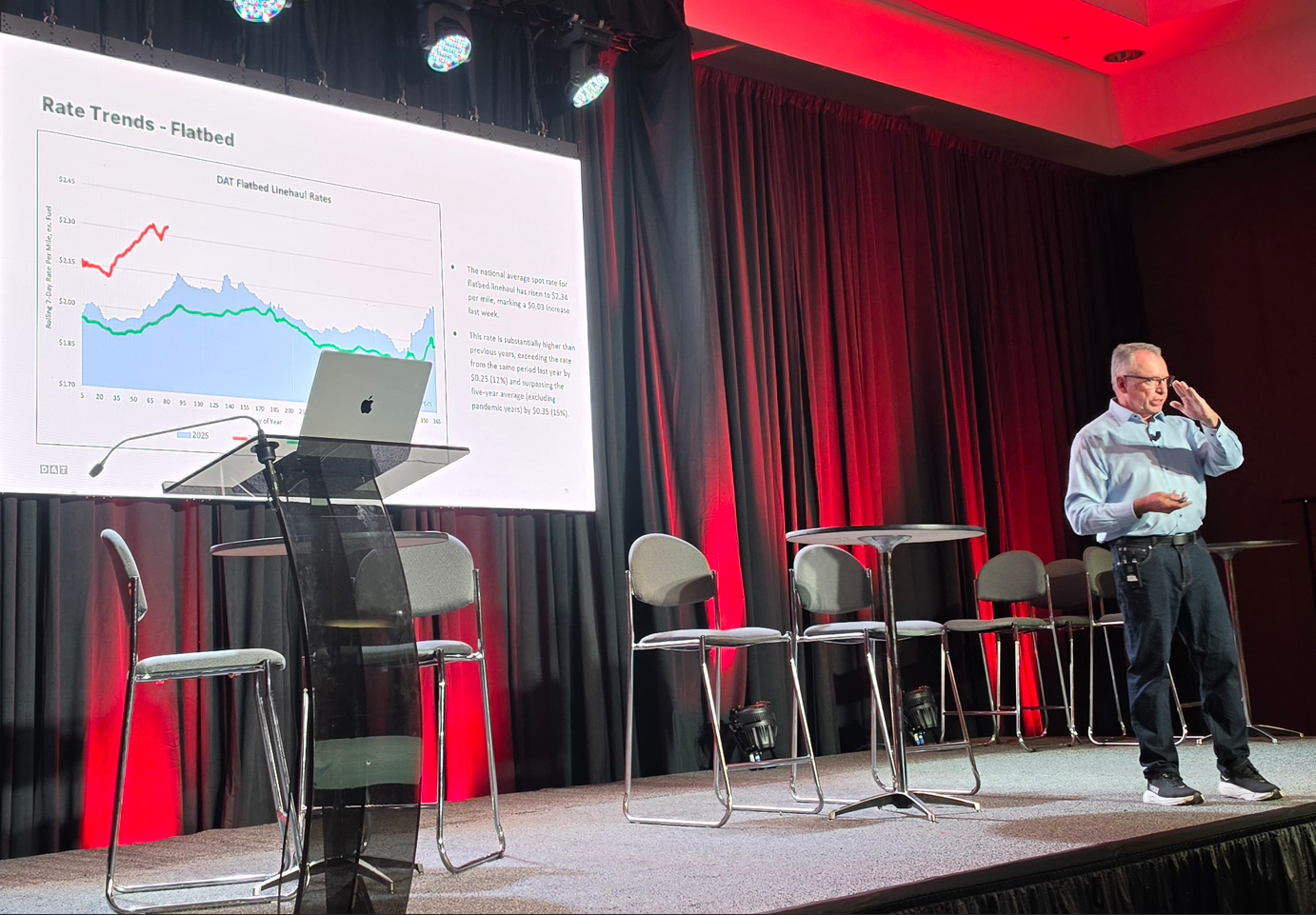
At the moment I'd be open deck. I'd be open deck specialised in a heartbeat and I'd focus on anything to do with data construction, data centres. I think that we're going to ride that wave for quite a while. Has open deck been historically the most stable?
Has been, especially in the last 2 years. It's been really good, mainly because because of the AI generational boom that we're seeing. What does ChatGPT and Open Deck rates have in common?
So data centers, they need these massive data centers to process all of this information.
I can type a question into ChatGPT or Claude and I can get information that might've taken me 3 hours to put together through research. I can get it in 3 seconds.
So that takes enormous computing power and the computers have to be close together physically in these massive data centers. And, and so they need space.
So where do you have space? Well, you don't have space in big cities. You have it in open areas where you're in the middle of nowhere. And that means a truck needs to haul something to the middle of nowhere to unload with a crane or a forklift.
And then there's a long deadhead mile component out of it to the next freight market.
So you add in the rate for the empty miles into the loaded rate and spot rates have been higher.
So they need to build a building, supply the storage, the data storage, Data storage, air conditioning, air conditioning machines, tractors, Bobcats, skid steers to build, to landscape the area. And all that goes on?
All it goes on open deck trailers. And I think that's— and it's such a specialized market. You really got to know your stuff as a flatbedder. That's a market that I think will always be specialized.
If someone wants to get into trucking the next few years, we can assume that open deck will be safe. I think open deck is going to be a really strong market, but it's a tough market, physically tough, because you're up and down offloads, chaining, strapping. Tarping, like it's tough and it's winter, it's cold.
So you gotta really be serious about it being a profession, but it will pay dividends.
If you're an owner-operator and you're watching the news, what should you be looking for? What kind of information will give us, will be an indicator for the future besides fuel prices? Yeah, I think my advice is study the market that you haul freight in.
So if it's computer electronics, if it's combine harvesters, if it's roofing shingles, you've gotta become an expert in the demand in that sector.
Not trucking, you don't wanna read trade magazines around trucking. You wanna read market-related material to that sector and study the demand for it and say, where's that market going? 'Cause that'll put loads on your truck, or not, if the market's collapsing.
So you gotta study, more than anything, the demand for what you haul first, 'cause then that tells you about where the rate's going to be and where you need to be physically located with your truck.
So the open deck guys, they should be pretty solid in the future.
Yeah. The reefer guys have the seasonality going for them. What about dry vans? Dry vans are hard to separate yourself from the pack.
It's about time and distance. Like, what else can you do with an 18-wheeler that's a dry van? Like, you're— it's a commodity. It's very hard to differentiate yourself in that market.
But again, it's about location.
It's knowing the markets where the freight's hot, where it's not, because reefer rates are going to go up this year, that means the dry van market also tightens because the reefer guys that have been in the dry van market go back to reefer and there's fewer trucks in dry van. Is the capacity still falling? Slowly.
It's not fast enough for most, but capacity is decreasing. But most of the carriers that shouldn't be in the business, most of the drivers, they're in the dry van division. Is that right? I would argue they're mostly in the refrigerated business because it's a live load, one trailer, one truck market, which is the hardest to work in.
Compared to drop trailer companies, companies who have drop trailer pools where you can do drop and hook. It's a different market.
You know, the immigration side of it and migrants have tended to go to where nobody else wants to be. That's every industry, right?
That's reefer. It's reefer. And it's food services and beer and docks and loading time and wait times because you've got to live load, live unload. Takes hours.
So a lot of fleets don't want that. They want drop and hook and turn and burn.
So that's, that's why there's certain pockets have— I think the immigration enforcement has disproportionately affected the refrigerated sector because that's where a lot of our minority truckers have ended up, particularly in California. How does DAT help owner-operators?
With information. Like I shared a lot of information here at MATS for a lot of customers that aren't DAT customers, because if the industry is healthy, that helps us because more carriers will want to use our services down the road.
So we want to be a good partner. We've got some good factoring products that help carriers carriers factor loads within 15 minutes, most of it's within an hour and a half.
It's non-recourse factoring, there's no comeback on the owner-operator, so they're good cash flow type products.
So we've tried to build products that help carriers not put barriers up in the event that something fails, like if a shipper goes bankrupt and fails to pay, well, that's on DAT. Dean, thank you so much for all the information. Good to meet you, I watch all your content.
Yeah, I'll see you around. All right, thank you.
.png)

.png)



.png)
.png)