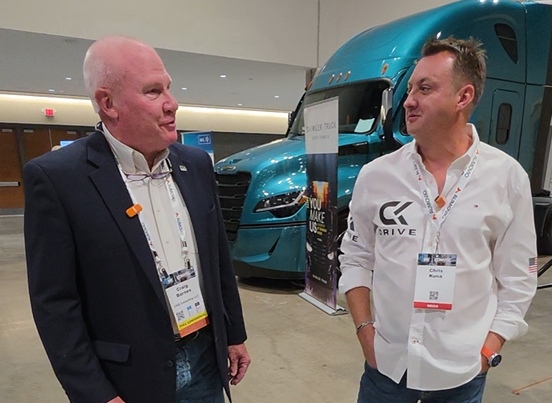
Diesel is not dead, so that's probably the main propulsion system in, you know, the types of vehicles we work with. But for some areas, it was just said this morning, they used the term diesel is still king.
And also for like a Class 8 vehicle, you know, battery electric is pretty heavy today and that takes away payload. You take away payload, I don't make as much money.
My name is Craig Barnes and I'm a retired Cummins executive and I have my own consulting business now. Last time I was changing some parts in my car, there's like an SAE and a number too. Do you guys have anything to do with the safety of each part of the vehicle? Well, we have standards by which components and electrical systems and stuff that they may have to meet to be legal.
So they're not federal standards, but they're industry adopted so that everyone makes parts that will meet the same standard. They're not necessarily interchangeable, but they all meet the same standards.
And so there's industry members who are parts of those societies who are always looking at safety, reliability, durability, new technologies. I mean, even AI right now.
So we have committees that work on them that They're always working on standards to make things safer and last longer. SAE division is called commercial vehicles.
So it's trucks, off-highway equipment, defense industry, anything that's not what you think of as a passenger car, that if it works for a living, you know, you see school bus over there, you see a truck. And a vehicle that makes money.
That's the whole thing of it is, of everything we're doing is our customers are in the business of making money. They're not into tech, they're into making money. With the development of AI, do you see more software-based companies in this area? Is it still a lot about hardware?
What's the ratio here?
Software is still a big part of it. You still have the mechanical side, as you see from the vehicles here.
So we still have to handle all of that going on.
But software, everything's electronic controlled now.
So you have automatic electronic automatic transmissions in vehicles, you have all the emission control devices that are all interacting. And in your personal opinion, from everything which you've seen, and you talk to all the engineers and experts, what's the future of transportation?
Let's say the next 5 to 10 years, where do you see AI and commercial vehicles?
Well, commercial vehicle diesel is not dead.
So that's probably the main propulsion system in, you know, the types of vehicles we work with. There's a new emission standard the EPA has that starts in 2027.
And so there's a lot of work has been done getting ready to meet that, which is a standard you have to do.
Then freight's not slowing down. Agriculture is not slowing down. Precision technology, and you're in the off-highway side for planting and taking care of crops, that doesn't get way. Trucking, well, there are now prognostics as well as diagnostics that they do.
The freight people are all tied in electronically to get, you know, to get the load from A to B. All of those features, there's no slowdown in this industry that we're seeing coming. And new technology is still there too. I mean, battery electric, you've heard about that.
They're looking at technology for hydrogen and alternative fuels. That's probably a little ways out because part of what this industry has to deal with is the number one criteria usually is there's an emissions standard. You have to meet that to play in the game. And after that, you have the features that go on in there.
And AI is supportive. It's used in the prognostics. We just had a big panel speaker on it this morning to help make things better, manufacturing related to this.
So the future just continues to be bright for this industry.
You mentioned the unpredictable fuel prices. Do you hear more chatter about the alternative energy sources like electric, hydrogen, and the commercial vehicles? There's more demand There's talk of it. There are pockets that are good, good places for it.
Like if you're in the drayage business on the coast or out and back each day in there, those make it. The cost of those hasn't quite gotten down yet. Again, our— the customers we tend to deal with are in business to make money. And if they can make money doing it and an alternative fuel works out for them and it's all worked out in the infrastructure, then there'll be a demand.
But for some areas, it was just said this morning, they used the term diesel is still king.
Okay. There may be a queen coming up, but right now the diesel is still gonna be key, even at the prices that it's at now, just because, you know, the standards in place for it to be, and the regulations are written such that if you use alternative fuel, you don't really get any credits or anything.
Okay, but natural gas is probably number 2, and like in the trucking business, there's some of those out.
But again, they're regional. Where does it make sense?
And also for like a Class 8 vehicle, you know, battery electric's pretty heavy today, and that takes away payload. You take away payload, I don't make as much money, you know, type of thing.