As fuel prices become increasingly unpredictable, fleets are searching for stability. Could electric trucks, alternative fuels, and new technology finally challenge diesel's dominance?
After attending several transportation industry conferences this year, one thing has become increasingly clear to me: fleets are looking for predictability.
The military conflict involving Iran and the resulting volatility in global energy markets have made that need even more urgent. Fuel has always been one of the largest operating expenses in trucking, but when prices rise dramatically in a short period, the consequences can be devastating.
Imagine operating a fleet of 500 or 1,000 trucks. If diesel prices were to double overnight, the additional fuel expense could reach millions, or even tens of millions, of dollars annually, depending on mileage and consumption.
For some carriers, that could wipe out an entire year's profits. For others, it could disrupt cash flow, delay investments, or even threaten the survival of the business.
And the troubling part is that fleet owners have very little control over it.
So, naturally, I keep coming back to one question: How much longer can trucking depend so heavily on diesel?
The Future of Trucking According to SAE
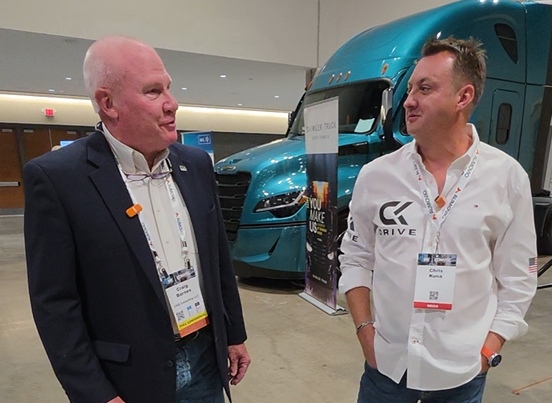
At SAE International's COMVEC conference in Schaumburg, Illinois, I had an opportunity to speak with Craig Barnes, a retired Cummins executive and longtime SAE International member who serves on the committee helping organize the commercial vehicle conference.
Craig has spent decades working around the engineers, manufacturers, and technologies that shape the transportation industry.
We talked about artificial intelligence, vehicle safety, engineering standards, new powertrain technologies, and the future of commercial transportation.
But one statement stood out.
"Diesel is still king."
Craig explained that while manufacturers are developing battery-electric vehicles, exploring hydrogen and alternative fuels, and introducing increasingly sophisticated technology, diesel remains the dominant power source for many commercial vehicle applications.
And there is a practical reason for that.
Commercial vehicles exist to do a job and, in most cases, make money. New technology has to make financial sense.
Electric trucks may be an excellent solution for certain regional operations, school buses, or vehicles returning to the same depot every night. Natural gas may be attractive in regions where fueling infrastructure is readily available.
But long-haul trucking presents a different challenge.
Battery weight can reduce payload capacity. Charging infrastructure is still developing. Vehicle purchase prices remain high, and availability of fuel or charging facilities can determine whether a technology works for a particular fleet.
As Craig pointed out, an alternative power source has to fit the application.
Technology Is Advancing, Even If Diesel Isn't Going Away
One of the fascinating things about attending these conferences is seeing just how much technology is being integrated into commercial vehicles.
Artificial intelligence, advanced electronics, software-controlled systems, and predictive maintenance are changing how trucks operate.
Instead of simply diagnosing a mechanical problem after something breaks, newer systems can help predict potential failures before they happen.
That means fewer unexpected breakdowns, better maintenance planning, and potentially more predictable operating expenses.
And predictability is exactly what fleets are searching for.
But while software and AI can improve efficiency and reliability, they cannot eliminate the financial uncertainty associated with global oil prices.
That brings us back to alternative energy.
The Rest of the World Is Already Moving
What makes this conversation particularly interesting is what is happening outside the United States.
According to the International Energy Agency's Global EV Outlook 2026, global electric truck sales more than doubled in 2025, with electric trucks representing approximately 9% of new truck sales worldwide.
China is leading that transition, where roughly one in four new trucks sold in 2025 was electric. Europe is also seeing growth, although electric trucks still represent a relatively small share of the market.
The American market is moving more cautiously.
Of course, these countries operate under different regulations, energy policies, economic conditions, and infrastructure capabilities. What works in China or Europe may not immediately work for an American carrier operating coast to coast.
Still, the direction of technological development is difficult to ignore.
The question is whether the United States will eventually follow the same path, or develop a different combination of technologies suited to its transportation needs.
Will Economics Eventually Dethrone Diesel?
I don't believe diesel trucks are going to disappear anytime soon. And after speaking with Craig, it is clear that the engineering community isn't expecting that either.
But I do wonder whether the economics of trucking could eventually accelerate a transition that regulations and environmental goals alone have struggled to achieve.
If fleets can reduce their exposure to unpredictable fuel prices, lower their operating expenses, and improve reliability by adopting alternative powertrains, the business case becomes much stronger.
And perhaps the future won't be defined by one technology replacing another.
We may see diesel continue dominating long-haul trucking, electric vehicles take a larger share of regional deliveries and urban operations, and natural gas become more attractive in specific markets.
Hydrogen and other alternatives may eventually find their place as well.
For now, every application has its own limitations and opportunities.
Diesel Is Still King. We'll See for How Long.
My biggest takeaway from this year's conferences is that transportation is changing rapidly, but the pressures facing fleet owners are changing just as quickly.
The industry isn't simply looking for cleaner engines or more advanced trucks. It is looking for solutions that make operations safer, more efficient, profitable, and, above all, predictable.
After all, what good is an efficient truck if an unexpected spike in fuel prices can erase the company's profits?
Craig Barnes offered a valuable perspective from decades of experience in commercial vehicle engineering. His message was clear: diesel isn't going anywhere just yet, but the industry continues to innovate.
I think the next few years will be fascinating to watch.
Will America continue relying primarily on oil to move its freight? Or will rising costs, technological advances, and global competition finally push the industry toward a more diversified energy future?
For now, diesel is still king. But every king eventually faces a challenger.
Watch my conversation with Craig Barnes from SAE International's COMVEC conference to hear his perspective on the technologies, engineering, and powertrains shaping the future of commercial transportation.