Trucking has always changed, but right now it feels like several major changes are happening at the same time.
Fuel prices are once again one of the industry's biggest concerns. Artificial intelligence is becoming more important. Autonomous technology continues to advance. Operating costs are climbing. At the same time, fleets are trying to figure out how to recruit and retain a workforce whose expectations are changing.
I recently talked with Rebecca Brewster, President and COO of the American Transportation Research Institute, about ATRI's latest research and the issues trucking professionals say matter most.
One thing that concerns me personally is the speed of technological change.
I am excited about new technology. I cover it constantly, and I believe much of it can make trucking safer, more efficient and ultimately better for drivers. But I also wonder whether some of it is arriving too quickly for the people who are expected to use it.
Think about a driver in their 50s who has spent decades learning how to operate a truck one way and plans to work another five or ten years. Suddenly we are asking that driver to understand increasingly sophisticated safety systems, digital platforms, AI tools and eventually perhaps an entirely different relationship between the driver and the truck.
Learning new technology is possible at any age, but the industry cannot simply assume everyone will adapt at the same speed.
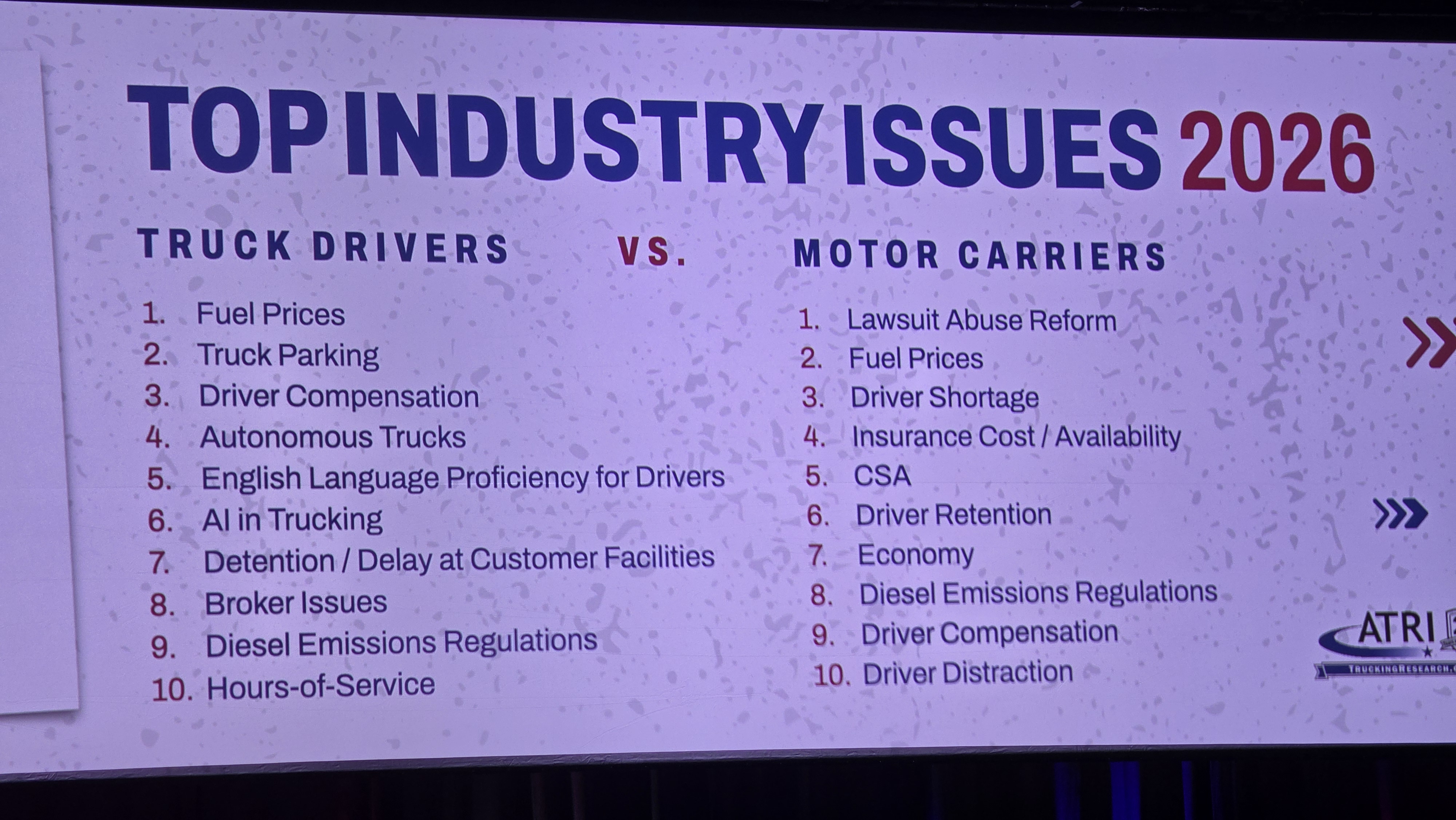
Another part of our conversation that stood out to me was the apparent disconnect between what drivers worry about and what carriers worry about.
Drivers may point to parking, home time or everyday working conditions. Carriers are thinking about costs, finding qualified drivers, retention and running a profitable business.
Rebecca made a simple point that I liked: if we fix one side, we often help fix the other.
Better truck parking, for example, isn't only a driver issue. If drivers are less frustrated and have better working conditions, they may be more likely to stay with a company. That makes it a retention issue for the carrier too.
The same applies to home time.
Younger drivers appear to value time at home more than previous generations, and fleets are recognizing that they cannot recruit and retain people based on pay alone. The supply chain still operates seven days a week, so balancing those expectations isn't easy, but it is encouraging to hear that carriers are taking retention more seriously.
I was also glad to hear Rebecca talk about opportunities for women in trucking.
ATRI's research shows that women are not only capable professional drivers but perform very well from a safety standpoint. What I found particularly interesting is why many women say they choose trucking in the first place: independence, freedom, enjoying the driving itself and competitive pay.
Those are qualities the industry should be promoting much more aggressively.
There is a lot more in my conversation with Rebecca, including fuel prices, artificial intelligence, autonomous trucks, driver shortage concerns and what ATRI's latest survey says about where trucking is headed.
Rather than give away every finding here, I encourage you to watch the full interview.
And if you are a driver, owner-operator or motor carrier, consider participating in ATRI's future surveys.
Good industry research depends on good data. The more people who participate, especially working drivers and carriers dealing with these issues every day, the more accurately that research can reflect what is actually happening on the road.
The industry is changing quickly. The best way to make sure those changes work for both drivers and fleets is to make sure both sides are part of the conversation.