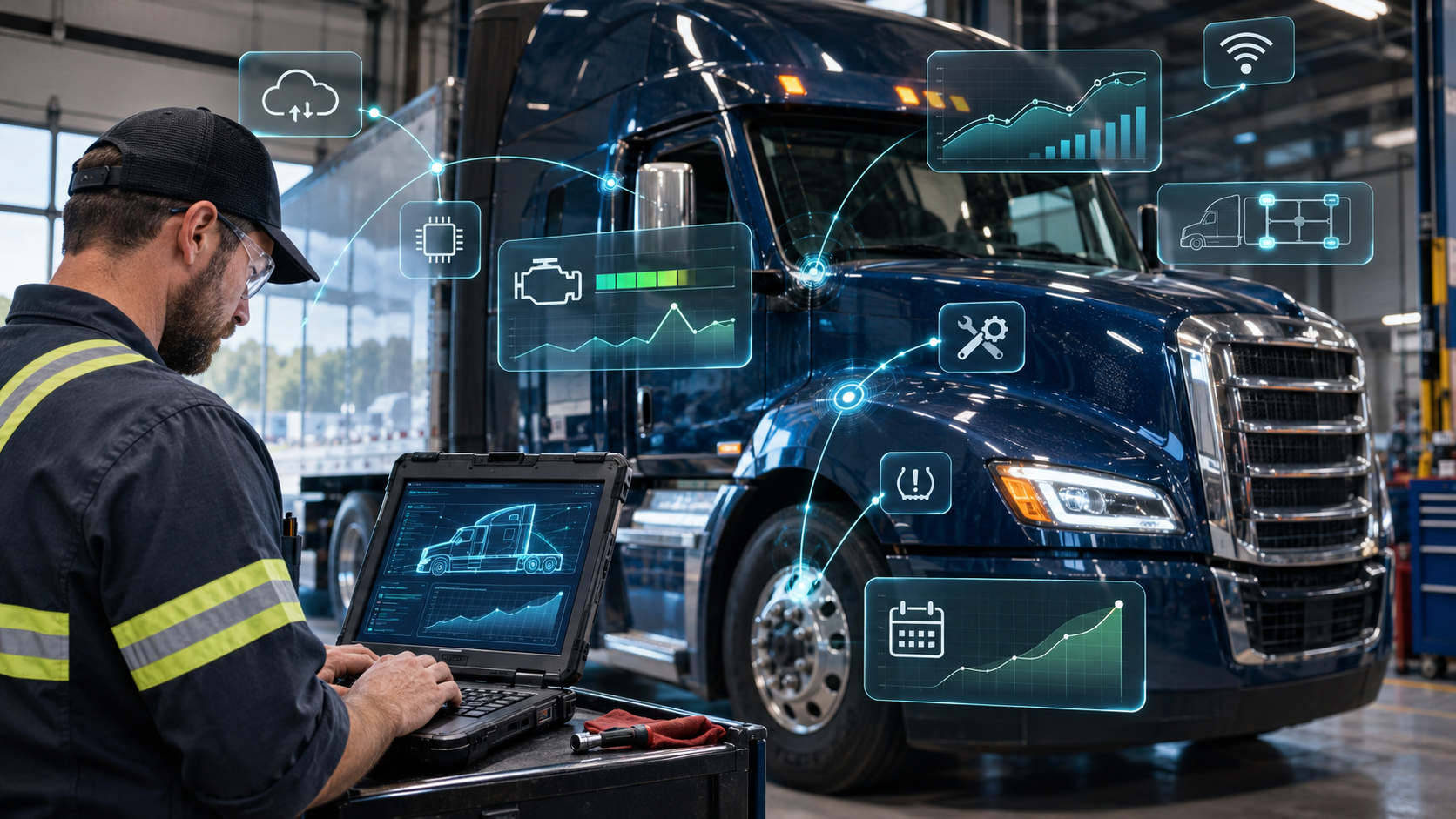
Artificial intelligence and software-defined vehicles could change how fleets maintain their equipment, prevent costly breakdowns, and improve efficiency. After years of owning a trucking company, I can tell you why that matters.
Every Fleet Owner's Nightmare
When I owned Kuna Cargo and operated my own fleet of trucks, one of my biggest frustrations was unexpected mechanical breakdowns.
And somehow, they always seemed to happen thousands of miles away from home.
A truck would break down somewhere across the country, far from my trusted mechanics, and suddenly a routine day turned into an expensive logistical nightmare.
First, there was the towing bill. Then came the mobile repair service, often charging outrageous prices because they knew you had few alternatives. If the truck needed to go into a shop, you were at the mercy of someone else's schedule, labor rates, and parts availability.
But the repair bill was only part of the problem.
In trucking, downtime can be even more expensive than the breakdown itself.
You can't simply put your driver into another truck when they're stranded 1,500 miles from home. The load still needs to be delivered. The customer is waiting. And if you're hauling refrigerated produce, every hour matters. Delays can affect product quality, lead to cargo claims, and turn an already expensive repair into a much bigger financial loss.
I remember thinking how much easier running a trucking company would be if I had a crystal ball.
What if I knew that a turbocharger, sensor, or another critical component was going to fail next week?
I could bring that truck back to my shop, have my trusted mechanic replace the part, and schedule the work around the truck's normal operations.
No emergency towing. No overpriced roadside repairs. No stranded driver. No missed delivery.
It sounded like wishful thinking back then.
But after my recent conversation with Julian Soanes of KPIT Technologies, I'm starting to think that crystal ball might actually be on its way.
Can AI Really Predict a Mechanical Failure?
At SAE International's COMVEC conference, I spoke with Julian, who leads aftersales activities at KPIT Technologies, a company specializing in automotive and mobility software.
We discussed how artificial intelligence, vehicle connectivity, and the emerging generation of software-defined trucks could transform commercial transportation.
One of the most interesting developments is predictive maintenance.
Modern trucks already generate enormous amounts of data through sensors, control modules, and connected systems. As those capabilities improve, AI-powered software could analyze the data, recognize patterns, and identify warning signs that might otherwise go unnoticed.
Instead of simply telling you what broke, the technology could increasingly warn you about what is likely to break.
I asked Julian a simple question: Could I know that my turbocharger was about to fail before it actually failed?
His answer was yes.
He explained how future systems could monitor vehicles and notify fleet operators about potential failures, allowing them to coordinate repairs with regularly scheduled maintenance.
Think about what that could mean for a fleet operating hundreds of trucks.
Instead of reacting to an unexpected failure somewhere along I-80, you could potentially schedule a repair before that truck leaves your terminal.
Of course, predictive maintenance won't eliminate every breakdown. Mechanical failures can still happen without warning, and predicting a problem doesn't physically repair it.
But even preventing a portion of those unexpected roadside failures could make an enormous difference to a trucking company's bottom line.
Same Truck. Same Engine. Completely Different Performance?
Another part of our conversation really made me think.
I've always looked at commercial trucks primarily as mechanical machines. You choose an engine, transmission, axle ratio, and other specifications based on the type of operation you're running.
Once the truck is built, most of those major mechanical characteristics are fixed.
But Julian introduced a different perspective.
What if you could take two mechanically identical trucks and optimize how they operate through software?
Imagine one truck hauling heavy loads through the Rocky Mountains, while another operates primarily on flat Midwestern highways.
Same engine. Same transmission. Same basic hardware.
But their operating conditions are completely different.
Julian explained that software-defined vehicles could allow much greater flexibility in adjusting vehicle parameters based on factors such as load weight, altitude, driving conditions, and how the equipment is being operated.
That could mean better fuel efficiency, more appropriate vehicle performance, and potentially less unnecessary wear on components.
For specialized fleets, the possibilities are particularly interesting.
A truck working in construction, a refrigerated carrier running long distances, and a regional delivery vehicle all have different operating needs.
Why should they all operate with essentially the same software configuration if their jobs are so different?
Obviously, manufacturers would still need to work within mechanical, emissions, and safety limits. Software can't magically increase an engine's physical capabilities.
But the ability to adapt equipment more precisely to its actual application could create significant value for fleet owners.
When Did Trucks Become Computers?
Sometimes I think back to when I was first learning to drive, decades ago.
Cars were overwhelmingly mechanical machines. Carburetors, transmissions, heating controls, and practically everything else relied on mechanical components.
Electronics played such a small role compared with today that it almost felt like the headlights and taillights were the only electrical things you needed to worry about.
If something went wrong, you opened the hood and looked for a mechanical problem.
Today, we're driving vehicles with multiple computers, sophisticated sensors, electronic control systems, and software managing everything from engine performance to safety features.
And we're only getting started.
Julian talked about the transition toward software-defined vehicles, where more functions can be configured, enhanced, or updated remotely.
Think about how your smartphone receives a software update. You wake up the next morning and suddenly it has new features or works better than it did yesterday.
We're moving toward a future where commercial vehicles could increasingly receive certain improvements in much the same way.
That doesn't mean you'll be replacing a broken water pump through Wi-Fi. Physical components will always require physical repairs.
But software issues, system configurations, and some performance improvements could be handled without bringing the vehicle into a workshop.
And in an industry where every hour off the road costs money, that matters.
The Future Isn't Just About Electric Trucks
We spend a lot of time talking about electric trucks, hydrogen, autonomous driving, and alternative fuels.
Those are important developments, and they'll continue shaping transportation.
But conversations like the one I had with Julian remind me that some of the most meaningful changes might be happening inside the trucks we already recognize.
A diesel truck that can monitor its own condition, alert the owner before a critical failure, adapt its performance to a specific operation, and receive software improvements remotely could be a very different machine from the diesel trucks we've operated for decades.
It might look nearly identical on the outside.
And that's what makes this technology so fascinating to me.
From Reactive Repairs to Predictable Operations
Looking back at my years running Kuna Cargo, I can't help wondering how much money, time, and frustration these technologies could have saved me.
How many roadside breakdowns could have been avoided? How many loads could have been delivered on time? How many unexpected repair bills could have been replaced by planned maintenance?
I don't think AI will ever make trucks completely maintenance-free. And I certainly don't believe every promise made about emerging technology will become reality overnight.
But the direction is encouraging.
For fleet owners, the real value of AI may not be a truck that drives itself. It may be a truck that tells you when it needs attention, before it leaves you stranded on the side of the highway.
That's the kind of technology I wish I'd had when I was operating my fleet.
And that's one development I will be watching very closely.
Watch my conversation with Julian Soanes of KPIT Technologies on CK Drive to learn how software-defined trucks, predictive maintenance, and AI could change the future of commercial transportation.